

Singapore is preparing to revamp childcare leave for working parents. At National Day Rally 2026, Prime Minister Lawrence Wong announced that the current Childcare Leave and Extended Childcare Leave schemes will be merged into a single scheme for working parents with Singapore Citizen children aged 12 and below. Under the announced structure, each eligible working parent will receive 8, 10, or 12 days of childcare leave per year, depending on whether they have one, two, or three (or more) qualifying children. The start date has not been announced, and the Government said more details, including implementation and eligibility criteria, will be released later. Employers should treat this as a confirmed direction of travel, while keeping current entitlements in place until the formal rollout.
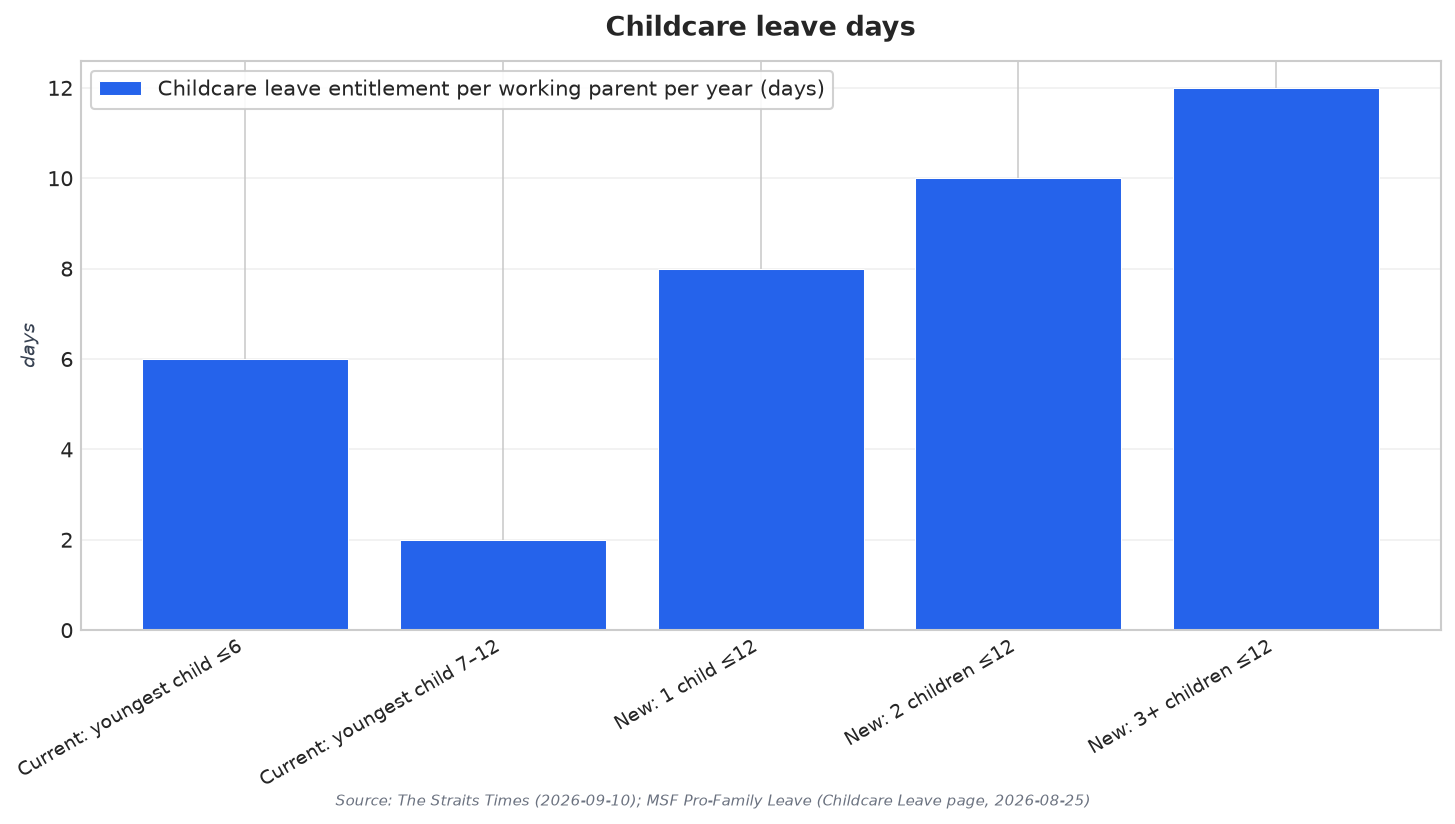
To understand the operational impact, it helps to contrast today’s rules with what is being proposed. Currently, each working parent gets 6 days of Government-Paid Childcare Leave per year when their youngest child is below age 7. This drops to 2 days of Extended Childcare Leave when the youngest child is aged 7 to 12. The MSF scheme page also notes a yearly limit of up to 6 days per calendar year across childcare leave types (including GPCL and ECL). The new approach removes this age-tiering and ties entitlement to the number of qualifying children aged 12 and below. One illustration shared publicly: a working couple with three children in primary school gets 4 days between them today, but would get 24 days under the announced scheme.
What Changes Most for Employers: Eligibility Logic and Cost Recovery
For HR teams, the Singapore childcare leave changes 2026 are not only “more days.” They also change the data you need to administer leave correctly. Instead of referencing the age of the youngest child to decide between 6 and 2 days, employers will need to track how many Singapore Citizen children an employee has who are aged 12 and below to determine whether the annual entitlement is 8, 10, or 12 days. This also means leave tracking should remain precise at the individual-employee level, because the cap applies per working parent, not per household. The intention of merging schemes has been framed as making the system simpler for parents and easier for employers to track, but HR teams will still need clean employee records and clear internal workflows to avoid disputes.
Cost is the other major employer-facing shift. HRM Asia reported that the Government will reimburse employers for the full duration of all child-related leave schemes up to the existing reimbursement cap, replacing the current cost-sharing approach. The list cited includes Government-Paid Maternity Leave, Government-Paid Paternity Leave, Government-Paid Adoption Leave, Shared Parental Leave, Childcare Leave, Extended Childcare Leave, and Unpaid Infant Care Leave. The Straits Times similarly reported full reimbursement for child-related leave up to set caps, aimed at easing the financial burden on employers and encouraging stronger support for working parents. Employers should plan for the administrative work of claims and verification, even if wage cost recovery improves.
Finally, leaders have signalled expectations on workplace culture alongside policy design. PM Wong asked employers to give employees confidence to take the leave they are entitled to, help them settle back into work afterwards, and ensure that becoming a parent “never becomes a disadvantage” in someone’s career. For HR, this is a practical prompt: align line managers, update handbooks only when official details are released, and prepare for conversations about scheduling and coverage when employees move from the current 6-or-2 day structure to the announced 8-to-12 day entitlement. Until the implementation date is confirmed, employers should not change leave entitlements yet, but can start preparing employee data and internal processes.
How many childcare leave days will an eligible working parent get under the new merged scheme?
What are the current childcare leave entitlements before the new scheme starts?
When do the Singapore childcare leave changes 2026 take effect?
Will employers be reimbursed for childcare leave and other child-related leave?
How can HR prepare if the detailed rules are not final yet?