
Singapore is moving toward a new pricing benchmark for early childhood care. At the National Day Rally on Aug 23, Prime Minister Lawrence Wong said fees at government-supported preschools will be cut to less than half of current levels to make caregiving more affordable. The monthly fees for full-day childcare and infant care will be reduced to S$150 and S$300 respectively by 2030. These lower fees will apply to every Singaporean child regardless of household income, and the amounts are before means-testing, so lower-income families will pay even less. The policy direction is framed as the government absorbing a much larger share of childcare and preschool costs.
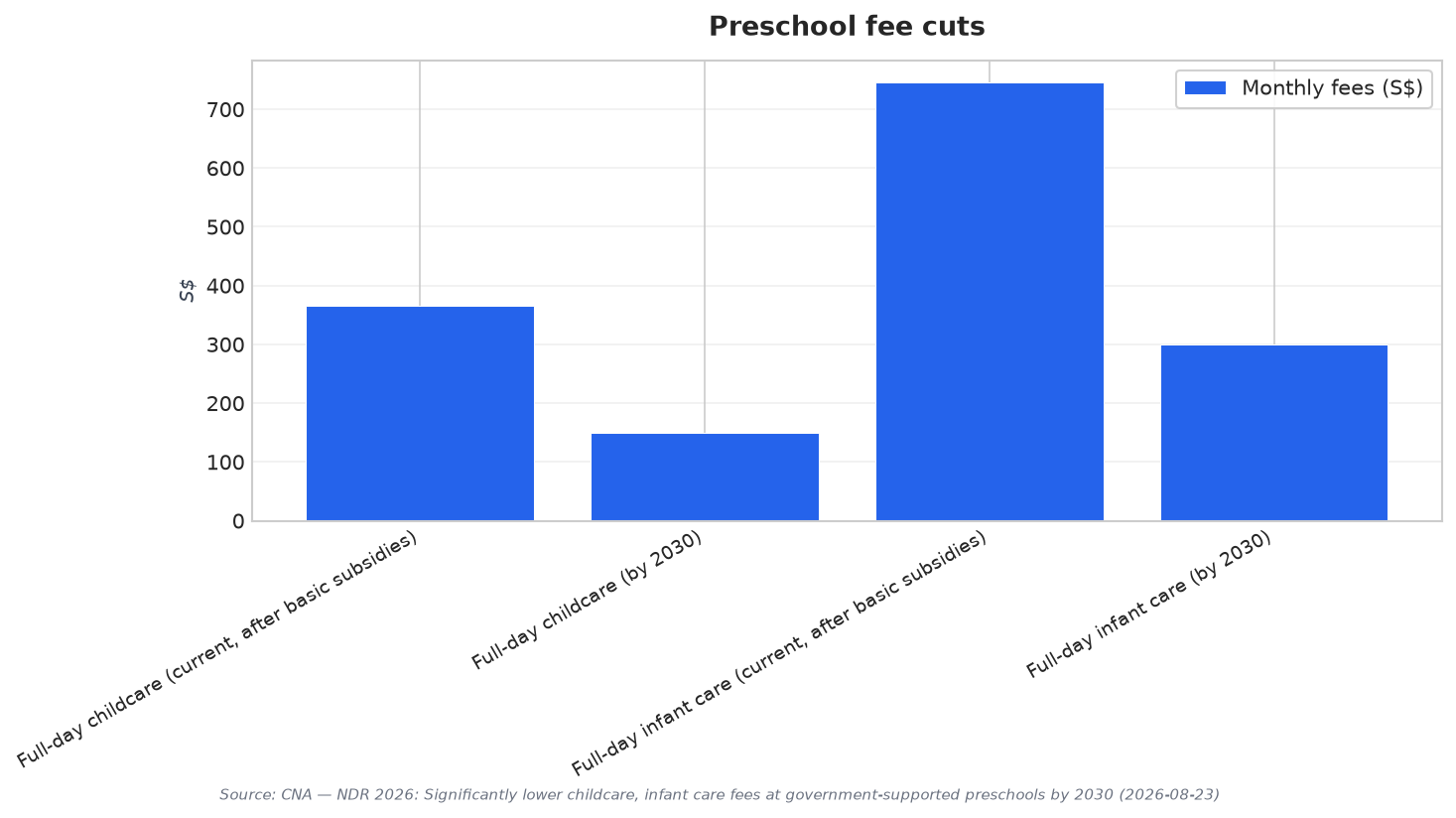
For families, the most immediate meaning is a clearer expectation of the out-of-pocket price within the government-supported network. Today, after basic subsidies, full-day childcare at government-supported preschools costs S$365 to S$559 a month, while full-day infant care costs S$746 to S$1,256 a month. Moving from these ranges toward the 2030 targets can materially ease monthly budgeting for parents who can secure a place. The fee reductions will be implemented progressively from 2028, with more details on the timeline to come out in early 2027. Prime Minister Wong also linked the approach to how primary education is kept affordable regardless of household income and whether both parents are working.
What Operators Must Watch as the Network Expands
The operator side matters because the lower fees depend on expanding supply inside the government-supported network. Government-supported centres today have enough places for about 80 per cent of preschoolers, and the government wants the lower fees to be more widely available. Prime Minister Wong said the network will need to expand significantly, with more help for eligible preschool operators that wish to join and meet requirements. As the network expands, fees will be brought down progressively. The Ministry of Social and Family Development and the National Population and Talent Division said a phased approach gives the sector time to adjust sustainably while maintaining high standards, which signals that cost pressures and service quality will be managed together.
This direction also sits within a wider set of family-policy recommendations. The enhancements are among the first recommendations from the Marriage and Parenthood Reset Workgroup to be accepted by the government, with a fuller set of recommendations expected in early 2027. In parallel, Singapore will extend full childcare and infant care subsidies regardless of the mother’s working status, according to reporting on the announced reforms. While the headline discussion often focuses on the future S$150 monthly fee, families will still need to find an available place with a provider in the network, and access will depend on how quickly capacity expands and operators join under the required conditions.
Globally, the childcare sector is also being shaped by affordability programs and subsidies, which can shift how operators plan revenue and capacity. Mordor Intelligence projects the global child care market will expand from USD 263.86 billion in 2025 and USD 274.71 billion in 2026 to USD 354.81 billion by 2031, registering a CAGR of 5.25% from 2026 to 2031. It also reports that government subsidies and vouchers are advancing at an 8.12% CAGR to 2031, and that center-based care commanded 66.36% of global market share in 2025. These figures are global context, but they underline why Singapore’s plan for preschool affordability by 2030 may require careful operator support, staffing resilience, and controlled expansion within the government-supported system.
How much are Singapore’s government-supported preschool fees expected to be by 2030?
Who will qualify for the lower fees at government-supported preschools?
What do current fees look like, compared with the 2030 targets?
When will families start to see preschool fee reductions in Singapore?
Why does expanding the government-supported preschool network matter for affordability?