
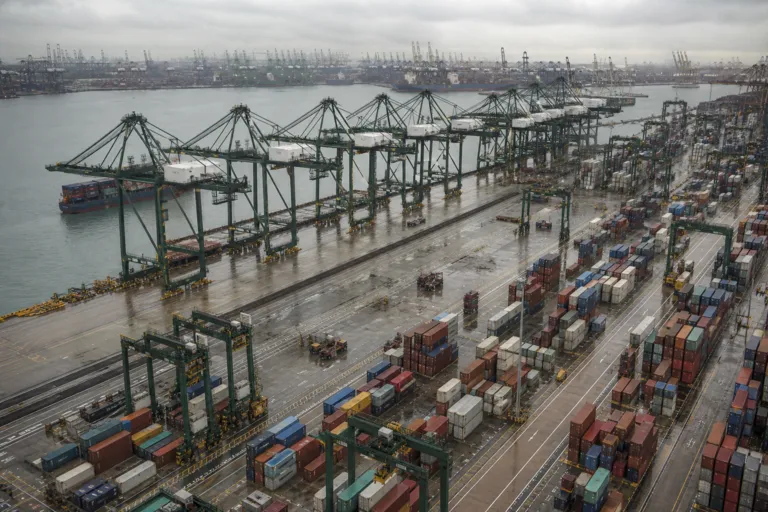
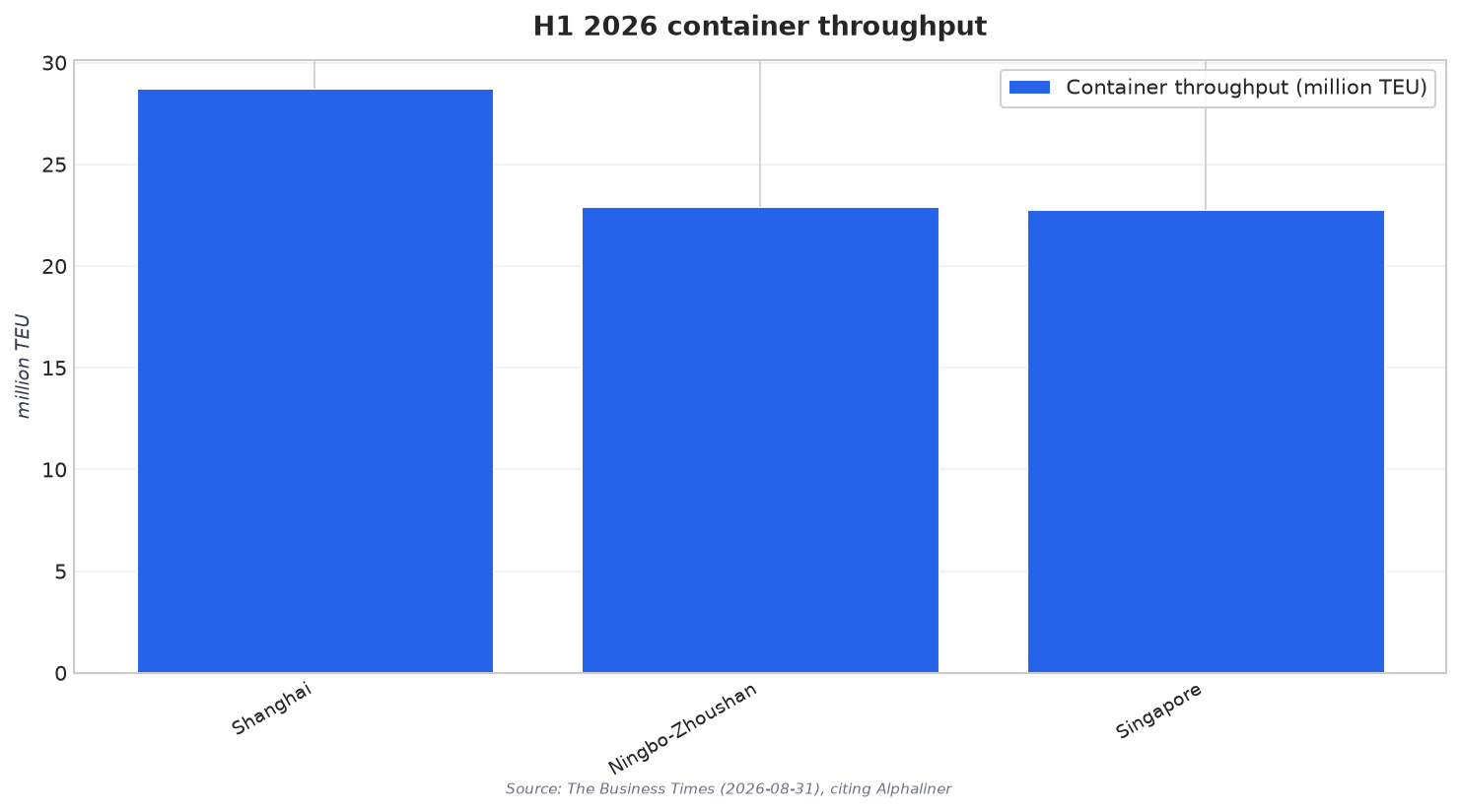
Singapore slipped to third place in global container port rankings in the first half of 2026, as Ningbo-Zhoushan edged ahead for the first time over a six-month period, based on figures cited by Alphaliner. Ningbo-Zhoushan handled 22.90 million TEU from January to June, representing 8.8% year-on-year growth. Singapore handled 22.74 million TEU over the same period, up 4.7% year on year. The change looks dramatic in rank order, but the volumes show a near tie that sets up an unusually tense second half where small shifts in cargo flow can change the headline.
The lead was measured in fractions of a month, not in structural dominance. One cited estimate put the difference at 158,310 TEU, while other reports described the gap as roughly 160,000 TEU. Xinde Maritime Network’s managing director, Chen Yang, argued that such a gap is equivalent to only one or two days of container handling at Ningbo-Zhoushan’s scale and warned that some ranking inputs can still be estimates that get adjusted when final figures arrive. That is why several observers stressed that the full-year outcome will depend heavily on second-half cargo flows, making it too early to declare a decisive annual shift.
Why Ningbo-Zhoushan Pulled Ahead—and Why the Lead Could Stay Fragile
The underlying story is not only throughput, but momentum and capacity. Linerlytica analyst Tan Hua Joo attributed Ningbo-Zhoushan’s faster growth to a major expansion in capacity that enabled it to handle increased volumes. Separate reporting linked the port’s rise to capacity expansion and network development, including the addition of 17 international services, alongside a note that the terminal increased volumes by more than 20%. Other coverage also pointed to the expansion of the Jintang container hub as a contributor. At the same time, competition among Southeast Asia ports was said to dilute Singapore’s growth, with notable gains mentioned for Haiphong and Cai Mep in Vietnam and Tanjung Pelepas in Johor, Malaysia.
For Singapore, slipping to third in H1 does not automatically signal a long-term decline, but it does tighten the strategic window. In 2025, Singapore’s container throughput reached a record 44.7 million TEU (also reported as 44.66 million TEU), while Ningbo-Zhoushan logged 43.87 million TEU. Those figures show how close the rivalry already was before the 2026 mid-year swap. Maritime Gateway also framed the next phase around how quickly Singapore’s Tuas expansion translates additional automated capacity into throughput gains. Meanwhile, Alphaliner expected the two ports to “duke it out” for the No. 2 spot going forward and suggested Ningbo-Zhoushan’s growth could taper as the year continued.
Context from the broader rankings underlines how volatile port positions can be when trade patterns or disruptions shift. In the first half of 2026, Shanghai remained the world’s largest container port with 28.7 million TEU and 6.2% growth. One report also stated that China’s ports handled a record 161.1 million TEU in H1 2026, up 5.8% year over year, which outpaced a 5.2% increase in the global container trade. Elsewhere, Jebel Ali’s fall—from 10th in 2025 to 32nd—was linked to a sharp volume drop to 3.1 million TEU from 7.8 million TEU, showing how quickly rankings can move. Against that backdrop, the phrase “Ningbo overtakes Singapore port ranking 2026” is best read as a mid-year signal: the contest is real, but the finish line is still the full-year totals.
What were Ningbo-Zhoushan and Singapore’s container volumes in H1 2026?
How small was the gap when Ningbo-Zhoushan moved ahead of Singapore?
Why did Ningbo-Zhoushan grow faster in the first half of 2026?
Does the Ningbo overtakes Singapore port ranking 2026 story mean Singapore will finish third for the full year?
Which port held the No. 1 global container ranking in H1 2026?