
When the Strait of Hormuz was effectively closed in early March 2026, the shock moved fast and wide. In 2024, roughly 84% of crude oil and 83% of LNG that transited Hormuz was destined for Asian markets, and in 2025 the IEA said about 80% of crude and oil product shipments and 90% of LNG exported through Hormuz were bound for Asia. Price expectations followed. CNA cited Rystad Energy projections that, even in an optimistic case where Hormuz reopened in April 2026, oil prices were projected to average about 50% higher than the start of the year, while spot LNG prices were likely to average 70% higher.
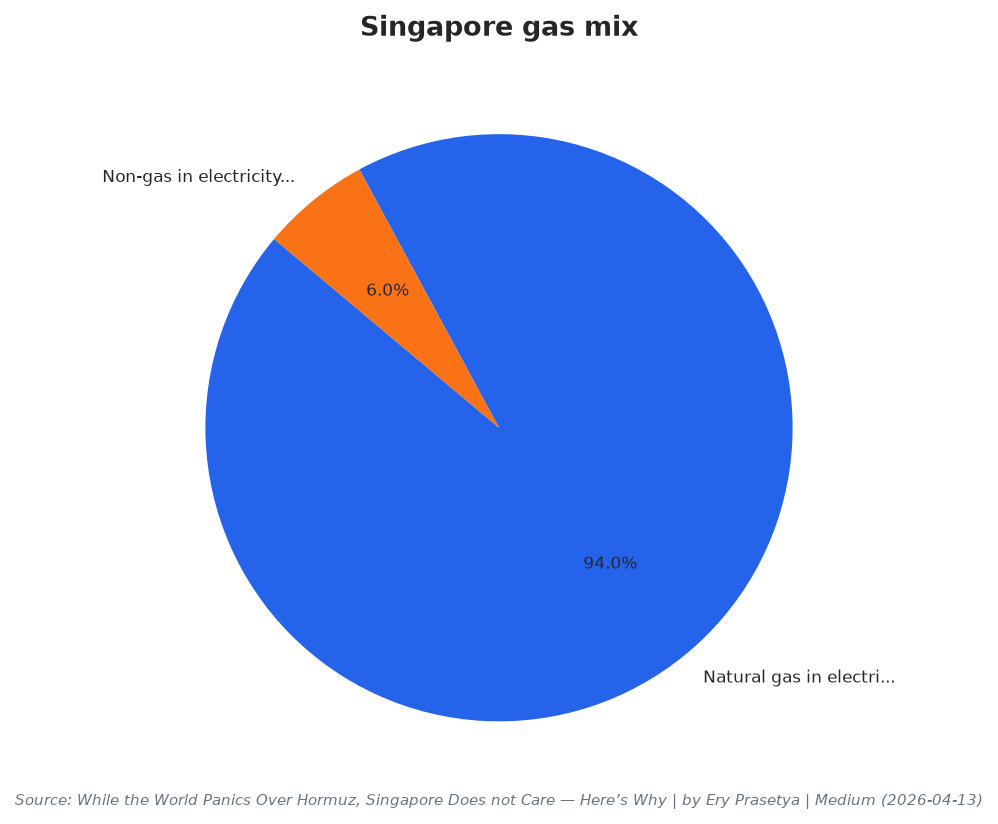
Singapore’s vulnerability was not theoretical. The city-state has no domestic oil or gas production, and it is plugged into a global system where Hormuz remains a critical chokepoint. At the same time, Singapore’s electricity supply structure created a different kind of resilience. As of 2024, Singapore generated 94% of its electricity from natural gas, with zero reliance on coal and zero reliance on crude oil as a direct electricity source. That meant the immediate power-system risk was less about oil-fired generation and more about the cost and availability of gas, especially LNG exposed to global shipping lanes.
How Singapore Reduced the Hormuz Link in Its Power Fuel Mix
Singapore’s core buffer in 2026 was that not all its gas was seaborne LNG. Sunollo wrote that Singapore generates about 94% of its electricity from natural gas, and of that gas, roughly 60% arrives via pipelines from Malaysia and Indonesia and is unaffected by Middle East disruption. About 40% arrives as LNG, and around 25% of Singapore’s gas comes from Qatar. During the crisis, Qatar’s LNG export capacity dropped by 17%, and Asian LNG spot prices doubled inside six weeks. Even so, pipeline gas acted like ballast for the power system when LNG markets repriced.
Prices still rose across the economy, highlighting that resilience is not the same as cheap energy. Sunollo reported Q2 2026 household tariffs were set at 27.27 cents per kWh, alongside an EMA warning of “further and potentially sharper” hikes in Q3. Maxthon also described pump price increases in early March 2026 across all octane grades, with Shell leading the increase and SPC holding prices as the sole outlier among major operators. Another layer of stress showed up in refined products: Behorizon reported Singapore gasoil prices surged 57% to 143.88/bbl, while jet fuel expanded 114% to 199.66/bbl.
Singapore’s longer-run shield in the same episode was governance and procurement design, not geography. CNA described the establishment of Singapore GasCo as part of a strategy to centralise gas procurement, seek more diverse sources, and aim for longer-term contracts to improve price and supply stability. This approach did not remove exposure to global LNG pricing, but it narrowed the single-point failure risk. In practice, the 2026 Hormuz episode showed why Singapore’s energy-security focus prioritised keeping the grid stable through shocks, even as international conflict turned fuel costs into a rapidly moving variable.
What made the 2026 Hormuz closure so disruptive for Asian energy markets?
How dependent is Singapore’s electricity system on natural gas?
Where did Singapore’s gas supply come from during the 2026 shock?
What happened to household electricity tariffs in Singapore during the crisis?
What does Singapore’s energy security around Hormuz-linked LNG show in 2026?