
For many households, the biggest stress in caregiving is that the needs are constant but the budget is not. The Enhanced Home Caregiving Grant (HCG), administered by the Agency for Integrated Care (AIC), is designed as a monthly cash payout to help families manage the cost of caring for seniors or persons with disabilities at home. From April 2026, the maximum payout increased to S$600 a month, up from S$400. The change was announced by MOH in a 7 March 2025 press release and took effect from April 2026. This update is why many families are now revisiting what support they can claim, and why the topic of Singapore’s Home Caregiving Grant in 2026 and its S$600 ceiling matters.
Eligibility centres on care needs and means-testing. The care recipient must permanently require some assistance with at least 3 of the 6 Activities of Daily Living: feeding, dressing, toileting, washing, walking or moving around, and transferring from bed to chair and vice versa. The care recipient must be a Singaporean or a PR (with a parent, child, or spouse who is a Singaporean). In addition, the grant is means-tested, and households with monthly per-capita income of up to S$4,800 can qualify (previously S$3,600). Some families assume they are over the limit and never apply, but the April 2026 change expanded coverage to those in the S$3,601 to S$4,800 band, which can matter for middle-income households.
How Much You May Get Each Month (And Why Tiers Matter)
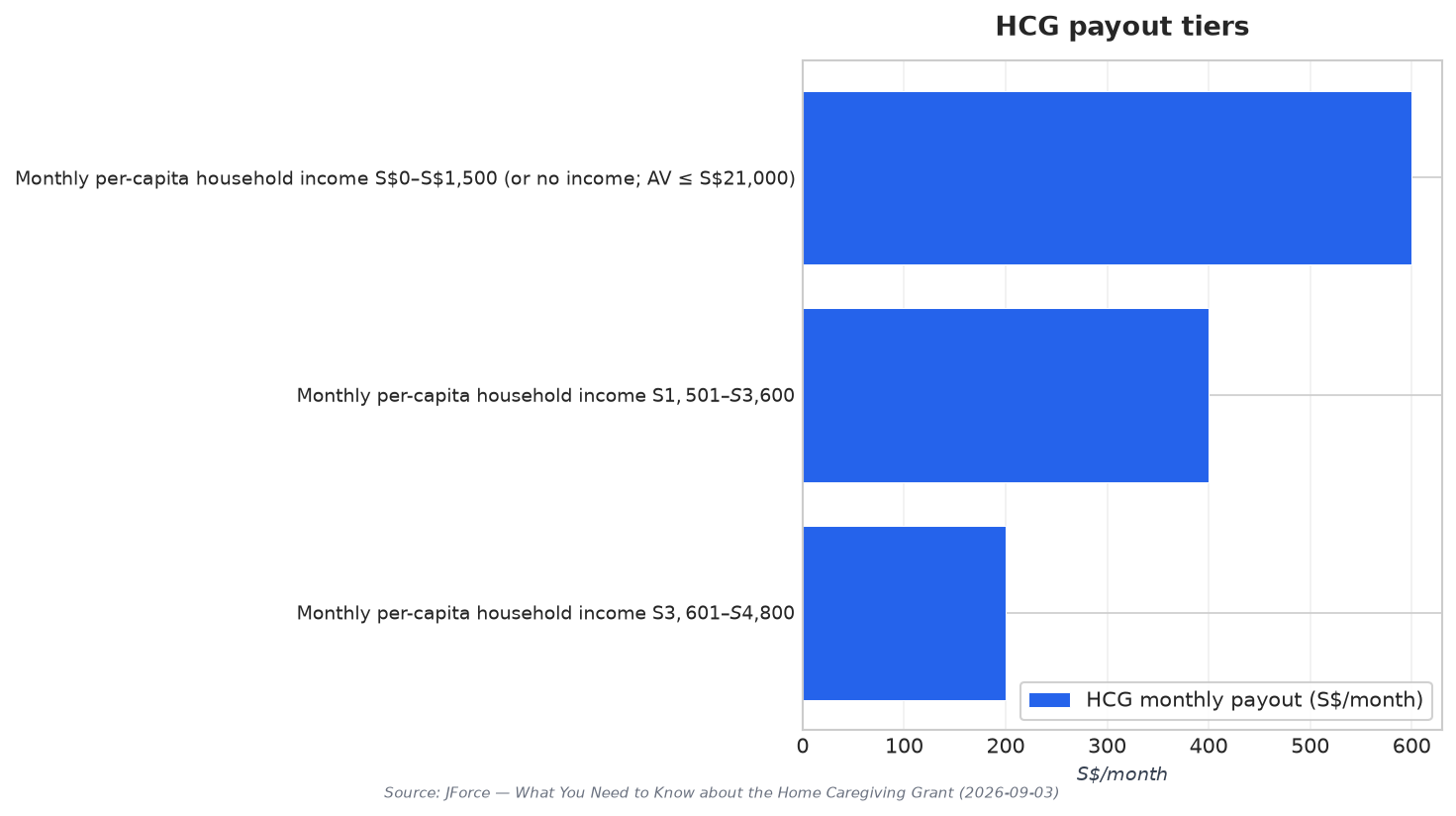
The headline is “up to S$600,” but what you actually receive depends on your monthly per-capita household income band and other means-test conditions. One published breakdown states that households with S$0 to S$1,500 per person may receive S$600 per month, those with S$1,501 to S$3,600 may receive S$400, and those with S$3,601 to S$4,800 may receive S$200. If the household has no income, the top tier can also apply where the property’s Annual Value is S$21,000 or below. If the care recipient owns multiple properties, AIC states that the lower S$200 tier applies. For 2026 subsidy levels, AIC uses 2025 Annual Values, so families are encouraged to check current household and property details when applying.
Just as important as the payout is what the cash can be used for. AIC describes the grant as flexible support for care needs such as hiring a helper (including a Foreign Domestic Worker), paying for home care services, and buying healthcare items such as adult diapers, mobility aids, and consumables. The grant is paid to a nominated bank account, which can help families plan recurring bills. Some guides also note that the HCG can be received alongside CareShield Life or ElderShield payouts and MediSave Care withdrawals, making it easier to build a fuller home-care budget rather than relying on a single source.
In practice, the impact can show up in day-to-day choices. One 2026 caregiving comparison estimates an eldercare-trained live-in FDW at about S$1,200 to S$1,600 per month all-in, while professional home caregiving is described at about S$25 to S$35 per hour. The same source illustrates a sample calculation of 4 visits per week for 3 hours at S$28 per hour, totalling S$1,344 per month before subsidies. Against those kinds of recurring costs, a monthly HCG payout (tiered up to S$600) can be a meaningful offset, especially when combined with other support that a household may already be eligible to receive.
What changed in Singapore’s Home Caregiving Grant in 2026, including the S$600 update?
What are the 6 Activities of Daily Living used for HCG eligibility?
How much can the Home Caregiving Grant pay each month in 2026?
What can families use the Home Caregiving Grant cash payout for?
Can HCG be received with other payouts?