

Singapore is planning to release a land parcel in the eastern region for a new not-for-profit private acute hospital, with capacity for 300 to 400 beds. The Ministry of Health (MOH) has said the tender is intended to create another lower-cost option for private healthcare and to ease pressure on the public system. The move would be the first private hospital land release in nearly two decades, with the last land tender for a private hospital cited as 2008, which led to the development of Mount Elizabeth Novena Hospital. MOH has said it is continuing consultations and aims to reach a decision in the second half of 2026, subject to final decisions, before proceeding with the tender.
What makes this proposal distinct is how Singapore plans to run the land tender. Under a fixed-price land model, the government sets the land price upfront, so bidders are not competing by paying more for the site. Instead, MOH has said bidders will be evaluated on qualitative factors such as care model, cost efficiency, approach to recruiting and developing manpower, and commitments to affordability and community value. The planned Singapore not-for-profit private hospital tender 2026 also includes bill-size restrictions, described as keeping bills within a certain percentile of the market so the new entrant does not “lead the market.” The intent is to direct competition toward quality and predictable pricing, rather than land-price escalation.
Why The Tender Design Targets Capacity Pressure and Costs
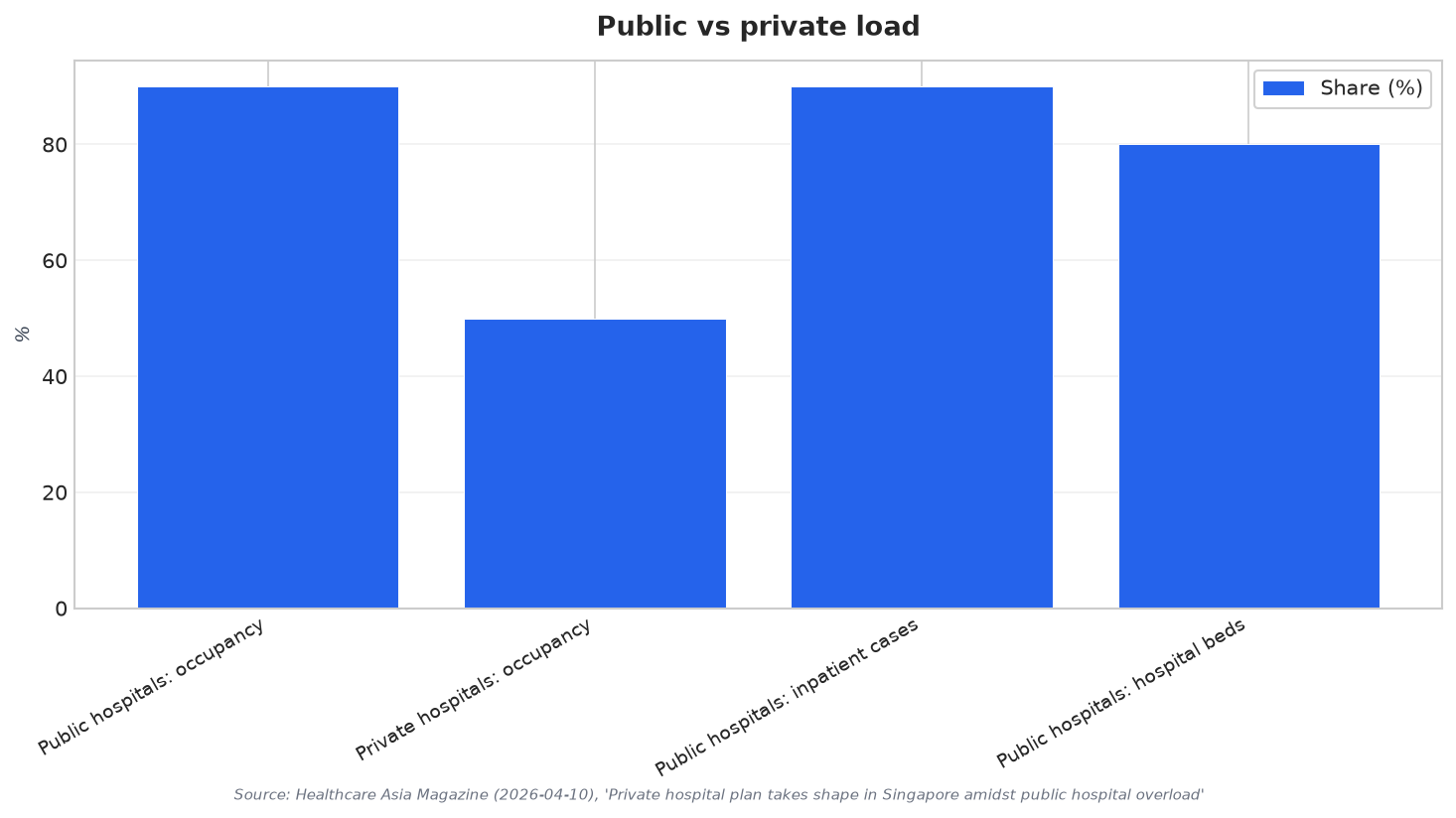
The tender is arriving in a context of uneven utilisation between public and private healthcare. Private hospitals have been described as operating at about half capacity, while public hospitals exceed 90% occupancy and handle about 90% of inpatient cases, despite accounting for about 80% of hospital beds. At the same time, around 40% of residents hold private hospital insurance, yet many still seek treatment in public hospitals due to cost considerations and clinical needs. Health Minister Ong Ye Kung has linked rising private hospital charges to insurance structures, including riders that became “overly generous,” encouraging higher utilisation and higher costs. He also said the cost gap between subsidised public wards and private hospitals has widened for similar procedures.
Policy tightening is already part of the broader backdrop to this hospital plan. Ong said the government tightened insurance rider requirements to focus coverage on large hospital bills, rather than smaller claims covered by deductibles and MediSave, and that the changes took effect earlier this month. MOH is also using tender design to avoid repeating earlier outcomes. Ong said that around 20 years ago, a private hospital land tender was won with a high bid price, and a high-end private hospital now occupies that land. He also said public healthcare lost many healthcare professionals to that private hospital, which was “very painful,” making MOH cautious about further private hospital expansion or expansion by existing private hospitals.
MOH has framed the not-for-profit model as a way to expand choices without turning the new hospital into a price leader. Ong cited Mount Alvernia Hospital as Singapore’s sole not-for-profit private acute hospital and an example that can exert competitive pressure on public healthcare. He also said MOH has received encouraging responses from potential operators, as well as enthusiastic donors and philanthropists, while continuing to address remaining issues ahead of a second-half 2026 decision. If launched, the tender’s fixed-price land structure, bill-size restrictions, and qualitative evaluation focus will test whether private sector participation can be anchored around care design, manpower development, and affordability instead of land-price competition.
What is Singapore planning to build under this new tender?
How is the fixed-price land tender different from a typical land bid?
When could the Singapore not-for-profit private hospital tender in 2026 proceed?
What restrictions will apply to pricing at the new hospital?
Why is MOH cautious about private hospital expansion?