
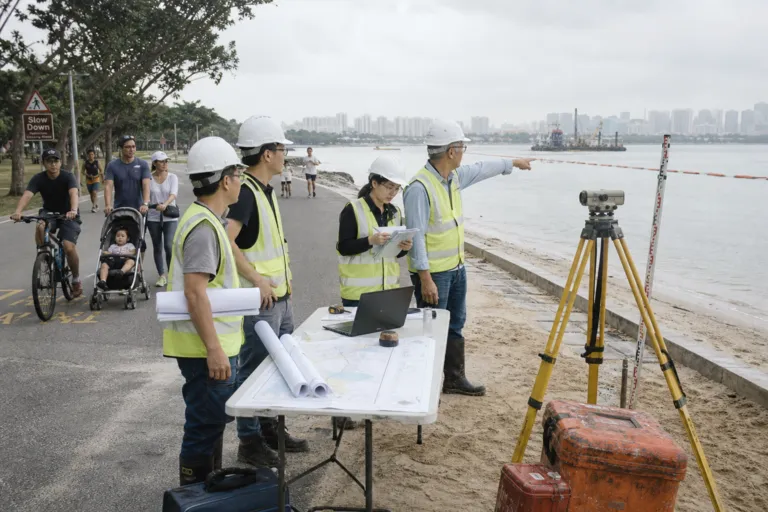
Singapore is set to begin a landmark coastal protection effort by the end of 2026, with preparatory works for “Long Island” starting after an environmental study, according to the Urban Redevelopment Authority (URA). The plan involves reclaiming about 800 hectares of land off the East Coast, potentially as a chain of “islands.” It is positioned as a critical measure to safeguard lives and livelihoods as rising seas increasingly affect low-lying coastal areas. The same initiative is also framed as a way to strengthen flood resilience while supporting future development needs.
The urgency is tied to how exposed parts of the country are. About 30% of Singapore’s land is less than five meters above mean sea level, including the East Coast area with homes, businesses, and Changi Airport. Based on Singapore’s 3rd National Climate Change Study, mean sea level surrounding Singapore could rise by up to 1.15 meters by 2100. When extreme high tides coincide with storm surges, sea level could rise up to 4 to 5 meters. In that context, Long Island is presented as a way to reduce risk to low-lying areas rather than relying on a single hard barrier.
What Long Island Includes Beyond Land Reclamation
The URA has described a package of elements planned for the project. Preparatory works are planned to include a reservoir, new islands, and the addition of more outlet drains, pumping stations, and tidal gates. In 2023, the government began technical studies, and the initial blueprint shared by the URA comprised three tracts of land connected by tidal gates and pumping stations, with engineering and environmental studies ongoing. Officials have also said they considered a basic seawall, but sought an approach that would retain residents’ access to the coast.
Long Island is also expected to reshape public space along the water. The URA says the creation of Long Island would add around 20 kilometres of new waterfront parks, forming part of a larger continuous 120-kilometre-long stretch of accessible waterfront space along Singapore’s southern coast. But the work will have trade-offs during construction. East Coast Park is used for water sports, and some activities will be displaced while the project is carried out. Sand infilling operations could also have minor impacts on air quality and on some coral and seagrass beds, based on the agency’s assessment.
Public engagement has already been significant, with more than 14,000 people contributing feedback, as agencies prepare for early-stage works ahead of eventual land reclamation. The first phase of works is set to be carried out west of Bedok Jetty off Singapore’s East Coast Park. A second phase is planned to commence after the Southeast Asian Games in 2029, because the waters in the area will be used for competition. For the Singapore Long Island reclamation project 2026 timeframe, the message is clear: the immediate focus is preparatory work, while the final profile and sequencing remain subject to further studies and public consultation.
How much land could Singapore reclaim under Long Island?
Why is Long Island being built along Singapore’s East Coast?
What sea level rise scenarios are cited by Singapore’s studies?
What is included in the Singapore Long Island reclamation project 2026 plans besides reclamation?
When will major phases of work take place, and where will it start?