
Singapore’s foodservice market outlook can look upbeat on paper, but the operating reality entering 2026 is harsher. Mordor Intelligence forecasts the Singapore foodservice market to grow from USD 28.92 billion in 2025 to USD 34.24 billion in 2026, and projects USD 79.73 billion by 2031 with an 18.42% CAGR over 2026–2031. Yet the competitive landscape remains intense and low in concentration, which can mean more direct head-to-head competition for similar diners. The result is a market that can expand while still forcing weaker formats and weaker cost structures out.
The exits are already visible. Between January and October 2025, 2,431 food and beverage outlets ceased operations in Singapore, according to Ministry of Trade and Industry data cited by Indonesia Business Post. In 2024, closures exceeded 3,000 outlets, averaging roughly 250 per month, and were described as the highest level of F&B exits since 2005. These closures included Michelin-starred venues and heritage brands, showing that the pressure is not limited to fringe players. At the same time, ASEAN Briefing notes that new establishments continued to enter the market in 2025, signaling ongoing capital deployment rather than a full retreat.
Cost Pressure Meets Demand Recalibration
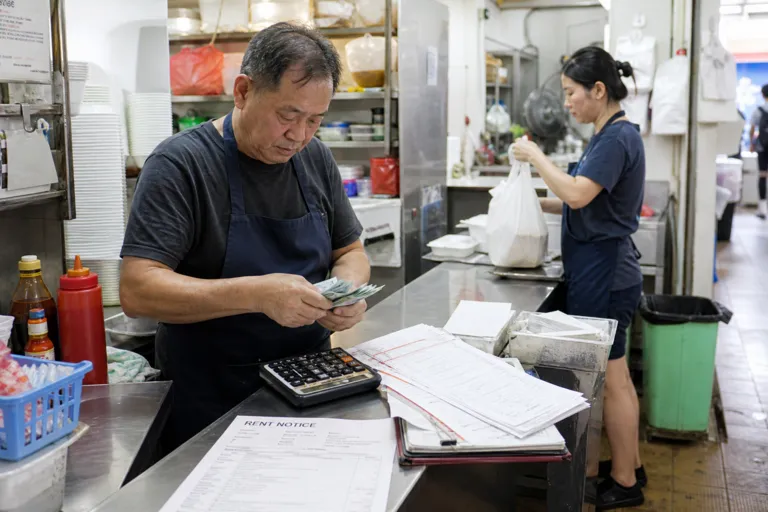
For many operators, the shakeout risk comes from a cost stack that is difficult to outrun with pricing alone. Zipdo reports that labor costs account for 35% of total operational costs for F&B businesses, while ingredient costs rose 12% in 2022 due to global supply chain issues, and 40% of F&B businesses faced supply chain disruptions that year. Rental pressure is also explicit in prime areas, where average monthly rent for F&B premises was SGD 8,500 in 2023, up 5% from 2022. In central districts tracked by URA, Indonesia Business Post cites average rental growth over the past two years at 2.0% per annum in Kampong Gelam, 2.5% in Little India, and 1.0% in Chinatown.
Demand is shifting toward value and convenience, which can be brutal for higher-cost formats. Indonesia Business Post cites Department of Statistics Singapore’s Food & Beverage Services Index (June 2025): full-service restaurant revenue declined 5.6% year-on-year, while cafés, food courts, and similar formats saw a 0.1% contraction. Zipdo’s consumer indicators point to heavy dining frequency—Singaporeans dined out an average of 12.3 times per month in 2022, up from 9.1 times in 2019—yet operators still face thin margins. The Business Times adds that hotel F&B performance “softened slightly compared to 2024,” with outbound travel pulling local guests overseas, even as events like the Singapore Airshow and more MICE activity are expected to be promising in 2026.
Digital and channel shifts create both opportunity and new costs, which is central to Singapore F&B sector challenges in 2026. Funding Societies reports that in March 2026, food and beverage services sales increased 2.3% year-on-year to an estimated S$1.6 billion, and online sales made up 20.6% of total F&B sales. Zipdo adds that delivery orders accounted for 18% of F&B revenue in 2022 and 30% of businesses use delivery platforms, while Mordor Intelligence projects delivery to grow faster than dine-in, forecasting a 20.10% CAGR to 2031. Technology can help, but it is not automatic: Zipdo says AI-powered inventory management systems can reduce waste by 15–20%, and Mordor Intelligence argues that contactless ordering and loyalty programs can lift average revenue per customer while reducing labor costs. The operators that survive the shakeout will likely be those that combine differentiation with disciplined execution on rent, labor, and digital economics.
What evidence suggests Singapore is heading into an F&B shakeout in 2026?
Which costs are squeezing F&B operators the most in Singapore?
How are consumer preferences shifting across formats?
How important are online and delivery channels for revenue now?
What are the key Singapore F&B sector challenges in 2026 for operators trying to stay profitable?