
On 31 August 2026, the Monetary Authority of Singapore (MAS) announced a S$220 million commitment over three years under the renewed Financial Sector Technology and Innovation Scheme (FSTI 4.0). MAS positioned the plan as a way to strengthen Singapore’s FinTech ecosystem and accelerate innovation and technology adoption across the financial sector. The context matters. MAS said Singapore is home to more than 1,800 FinTech firms and close to 10,000 professionals working across technology, data, artificial intelligence (AI), compliance, cybersecurity, and business roles. MAS also stated that FinTech investments in Singapore hit S$2.9 billion in 2025.
FSTI 4.0 is structured around four goals. MAS said it aims to anchor and scale innovation activities in Singapore, accelerate the development and deployment of financial technologies with a focus on frontier technologies, build technology infrastructure that helps the financial sector adopt new solutions, and support talent development and attraction. The intention is not framed as a single bet on one subsector. Instead, it is positioned as a broader set of levers to keep experimentation, deployment, and capability-building moving inside Singapore—especially when the private market becomes more selective about where it puts money.
Six Tracks, With Talent as the Most Concrete Near-Term Lever
MAS said FSTI 4.0 will be implemented through six tracks spanning institutional innovation, AI adoption, infrastructure and platforms, and talent development. The most specific target disclosed is in the Manpower track. MAS will co-fund internship stipends and aims to support at least 1,000 FinTech internship opportunities over the next three years. A new FinTech Internship Portal, fintechinternships.sg, managed by the Singapore FinTech Association (SFA), is intended to connect FinTech firms with students from Institutes of Higher Learning for internships across business, technology, and other roles. This makes talent supply a deliverable, not just a theme.
On the technology side, MAS described an Institution Project track supporting Singapore-based financial institutions and FinTech firms as they develop and deploy innovative solutions, focusing on frontier technologies such as AI, Distributed Ledger Technology, and Quantum Technology. MAS also described an AI Pathfinder track to support scaling and adoption of market-ready AI FinTech solutions listed on PathFin.ai, a MAS-led initiative aimed at knowledge sharing and ecosystem collaboration. Separately, reporting on the scheme said financial institutions and Singapore-based fintech firms can receive up to 50% of qualifying project costs, capped at S$1 million for 24 months, with projects developed primarily outside Singapore excluded.
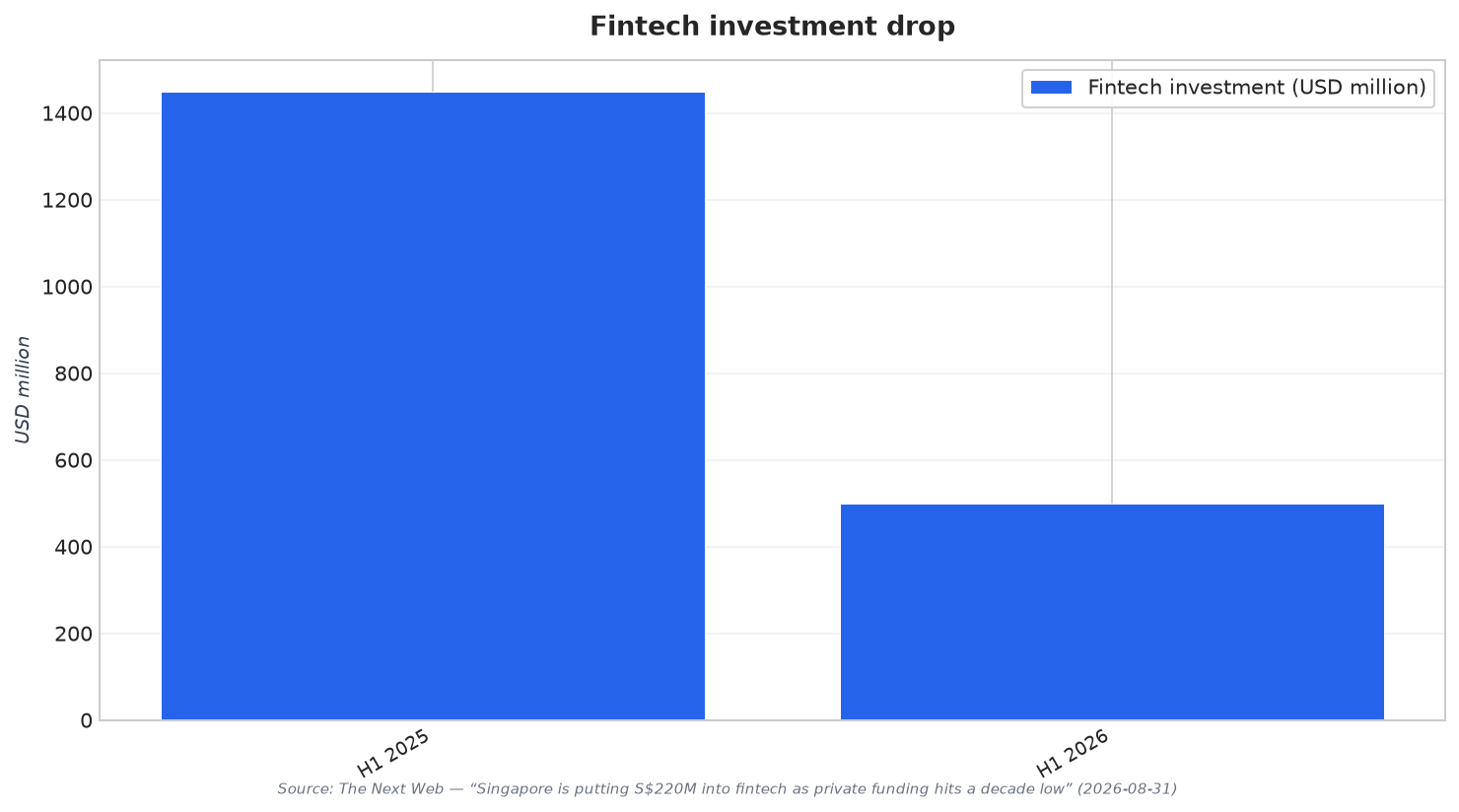
FSTI 4.0 also arrives as some reporting pointed to a softer near-term private funding climate. KPMG figures cited in coverage said Singaporean fintech companies raised US$499 million across 53 deals in the first half of 2026, down from US$1.45 billion across 97 deals in the same period a year earlier. The same coverage noted that a single US$320 million cross-border payments round accounted for nearly two-thirds of the first-half total, leaving roughly US$179 million for the rest of the market. Read together, the Singapore MAS FSTI 4.0 fintech funding 2026 story is less about replacing venture capital and more about lowering barriers to pilots, deployment, and hiring, so firms can keep building through a choppy cycle.
What is MAS committing under FSTI 4.0, and over what period?
How large is Singapore’s fintech ecosystem according to MAS?
What is the internship target under the FSTI 4.0 manpower track?
How does the Singapore MAS FSTI 4.0 fintech funding 2026 plan connect to AI adoption?
What do reported first-half 2026 funding figures suggest about the market backdrop?