
Singapore’s push for a lower-carbon built environment is anchored by the Singapore Green Building Masterplan (SGBMP), launched in March 2021 by BCA and the Singapore Green Building Council. The SGBMP frames building transformation around “80-80-80 by 2030”: green 80% of buildings by gross floor area (GFA), achieve Super Low Energy (SLE) in 80% of new developments (by GFA) from 2030 onwards, and deliver an 80% improvement in energy efficiency (compared with 2005 levels) for best-in-class green buildings by 2030. In that context, the Singapore built environment 80% energy efficiency target 2026 conversation is less about a single deadline and more about whether the sector is building credible pathways that work across different building types.
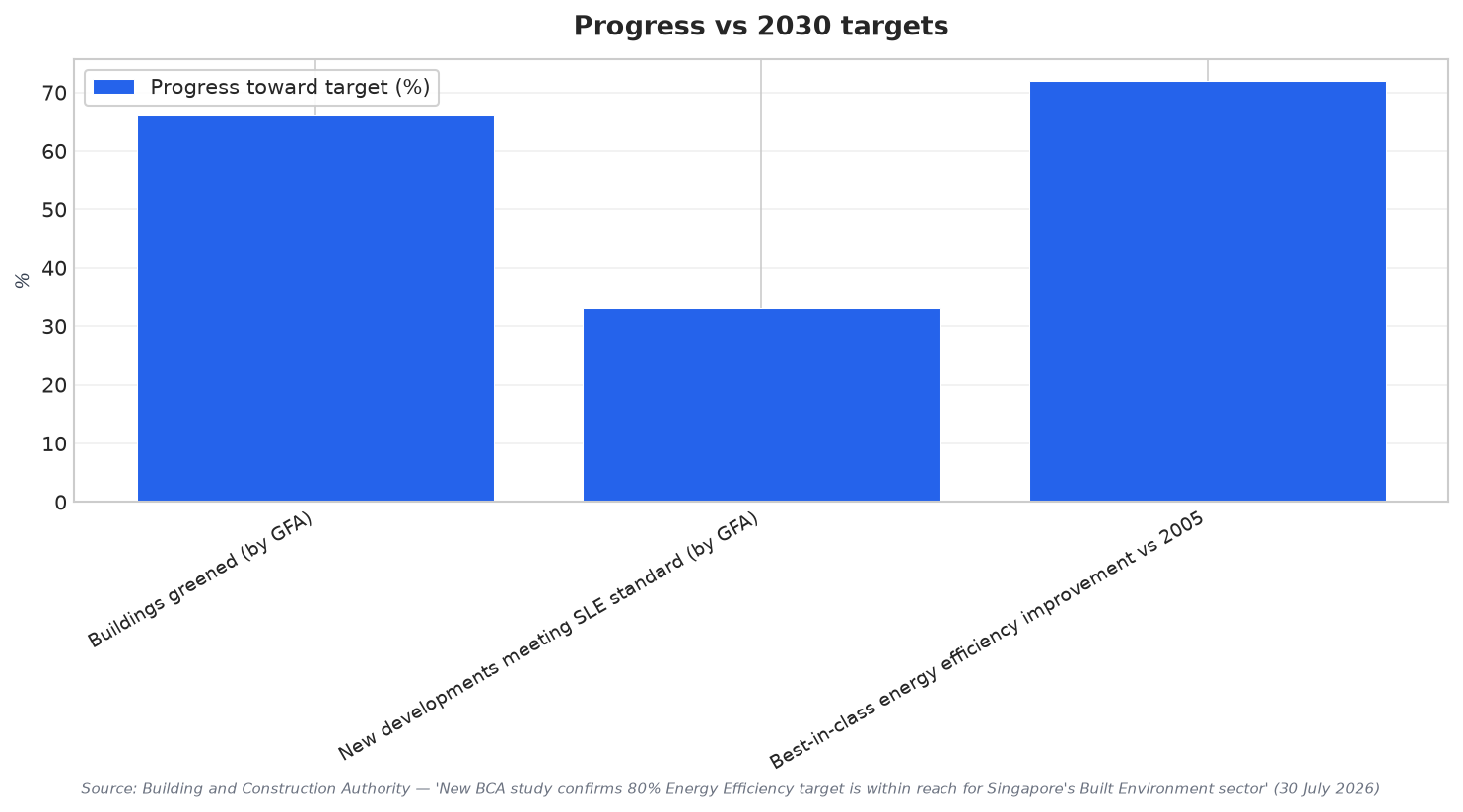
Progress markers are already visible in public reporting. In a July 2026 update shared by BCA, 66% of buildings by GFA had been greened toward the 2030 target, and approximately one-third of new buildings had achieved the SLE standard. For the best-in-class energy performance goal, BCA stated that best-in-class buildings had reached a 72% improvement in energy efficiency versus 2005 levels “thus far.” These numbers matter because they translate the masterplan into measurable movement, and they help building owners and tenants see that the remaining gap is not theoretical. They also underscore why standards and compliance routes, such as meeting minimum energy performance requirements or achieving Green Mark certification, remain central to how “green” progress is counted.
What “Within Reach” Looks Like in Practice
On 30 July 2026, BCA shared findings from its completed Design Prototyping for Decarbonisation (DPfD) study, stating that Singapore’s 80% improvement target (from 2005 levels) is technically feasible for new and existing office buildings, new hotel buildings, and new mixed-development buildings. The study assessed technical options and commercial viability, and proposed incremental decarbonisation pathways to account for varying financial, operational, and technical constraints. BCA highlighted two high-impact strategies. Plug load management was positioned as a practical lever for tracking and reducing energy use, with green leases enabling landlords and tenants to co-share cost savings. Alternative Cooling Technologies (ACTs), including Passive Displacement Cooling and Hybrid Cooling, were cited as capable of reducing building cooling energy consumption by 30% to 50% while maintaining thermal comfort.
Cooling is a decisive battleground for commercial buildings because BCA noted it accounts for 40% to 60% of building energy consumption. That makes ACTs a lever with outsize influence on overall performance, especially when paired with tenant-side measures that address plug loads. BCA also stated that more than 40 buildings in Singapore have adopted ACTs to date, showing that adoption is already happening beyond pilots. Separately, media reporting on SLE outcomes added commercial context: SLE is described as “defined as 60% better” in energy efficiency than 2005 standards, and developers of SLE commercial buildings were reported as typically recovering upfront investments within five to six years, before continuing to save on energy bills over the building’s lifespan.
These technical and market signals are reinforced by how Singapore has built the policy foundation over time. The Green Mark Scheme launched in 2005 and is regularly updated; minimum energy performance standards for new buildings were introduced in 2008, and from 2013 were extended to existing buildings undergoing major retrofitting works. Since the SGBMP, BCA launched Green Mark 2021 in September 2021, raising expectations by requiring at least a 50% improvement in energy performance compared with 2005 levels alongside good practices in other sustainability areas for certification. If “within reach” is the right phrase, it is because the sector is combining standards, operational changes, and targeted technologies to close the remaining distance from 72% toward the 80% best-in-class milestone by 2030.
What are Singapore’s “80-80-80 by 2030” Green Building Masterplan targets?
How close is Singapore to the 80% energy-efficiency improvement goal today?
What did BCA’s DPfD study conclude about feasibility for offices and hotels?
For the Singapore built environment, what does the 80% energy efficiency target in 2026 imply for building operators?
Why do alternative cooling technologies matter so much for building energy use?