
Singapore has taken a visible step toward collaborative contracting. JTC awarded a collaborative contract for infrastructure works at CleanTech Park in Jurong Innovation District (JID) to Eng Lam Contractors Co (Pte) Ltd, adopting the New Engineering Contract 4 (NEC4). JTC described this as the first public sector project in Singapore to implement this internationally recognised collaborative contracting framework. The immediate driver is practical: the construction sector has been facing risk management challenges, including cost overruns and project delays. In contrast to traditional contracts that allocate risks and rewards separately, NEC4 is positioned as a way to encourage collaboration and allow risks and cost savings to be shared more equitably among contracted parties.
The JID pilot is also a concrete test of what “collaboration” means in day-to-day delivery. The project involves extending CleanTech Loop from The Potter’s Garden (formerly Jurong Eco Garden) to the upcoming MRT station, and building an elevated walkway linking the station to the northern part of CleanTech Park. JTC said the works will improve access to public transport and enhance connectivity for commuters and road users. NEC4 itself is not new globally. It originated from the United Kingdom and has been adopted in other regions such as Hong Kong, where projects have achieved overall time and cost savings and parties have evolved to be more collaborative and cordial. In Singapore, BCA started looking at NEC4 in 2024 with NEC, and local adaptations were made to align the contracts with Singapore’s legal and industry requirements.
What Makes NEC4 “Target-Cost” Different in Practice
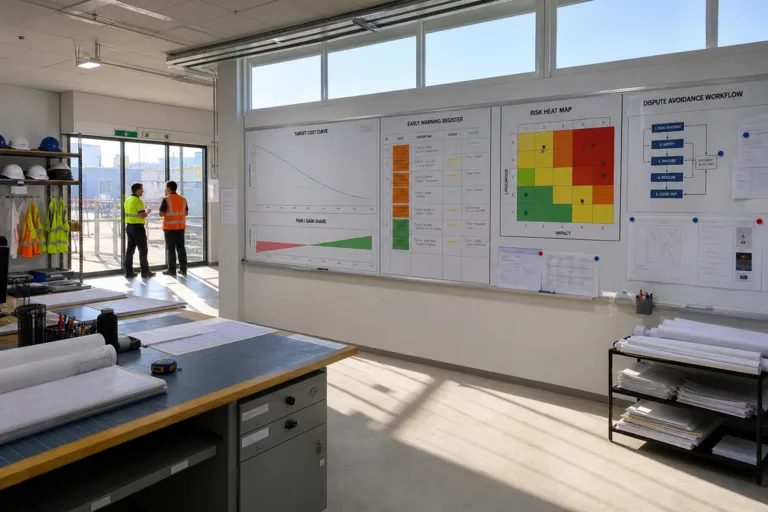
NEC4 emphasises collaboration and mutual trust through features that change incentives and routines. One is pain-gain share, where a target cost approach enables parties to share cost savings or overruns as they occur, rather than relying on a fixed lump sum contract. For Singapore NEC4 target cost contract construction discussions, this is a central shift: cost is managed transparently and jointly, with shared upside and downside. NEC4 also includes an early warning system so potential issues can be identified early and addressed before they escalate, supporting the goal of staying on track and within budget. A third element is holistic dispute management, promoting openness and transparency through clear communication and platforms for early issue identification and collaborative resolution.
Option choices matter, especially for larger or more complex projects. A Singapore Academy of Law guide notes that Options C and D are suitable where the client and contractor are willing to share project financial risks in a collaborative way, and it highlights that Option D uses a bill of quantities. In the JTC award, industry commentary has pointed to NEC4 Option C as the target cost contract used, and outlined how it works through a pain/gain share principle relative to an agreed Target Price. That commentary also describes “Price for Work Done to Date” (PWDD) as running reimbursement calculated as Defined Cost plus the Fee. At the same time, it stresses that Option C is renowned for administrative demands and introduces commercial exposures that contractors must manage diligently across the project lifecycle.
Regional experience shows how specific NEC4 settings can shape behaviours, but those settings are not automatically Singapore defaults. In an analysis of NEC4 contracts in Hong Kong SAR, the default value in the Hong Kong edition for sharing savings under certain mechanisms is 50%, meaning client and contractor split savings evenly. The same analysis notes that under a target cost model (Option C or D), the price remains unchanged when a proposal is accepted, and whether the contractor is ultimately rewarded depends on whether the final PWDD assessed on completion is less than the contract price, taking into account the pain/gain share percentage prescribed in the contract data. For Singapore, the bigger takeaway is directional: if parties can make early warning, transparent cost processes, and structured issue resolution routine, NEC4 could reduce the “dust-off-the-contract-only-when-there’s-a-dispute” pattern described by industry observers.
What is Singapore’s first public sector NEC4 collaborative contract?
How does a target-cost NEC4 contract share risk and reward?
Why could NEC4 reduce disputes and delays in project delivery?
What does the JID CleanTech Park pilot project include?
What should teams watch for in Singapore NEC4 target cost contract construction using Option C?