
Digital banking is now the dominant direction of travel. One global view cites 1.75 billion digital banking accounts processing approximately $1.4 trillion annually, described as about $2.7 million per minute. Another source says over 53% of the global population has migrated to digital-first banking. A separate statistics roundup adds that 73% of banking interactions now happen through digital channels globally. Together, these figures explain why regulators and banks talk about “digital first” as the default. But they also raise a practical question: if the system is designed around apps, what safeguards exist for people who still need physical touchpoints and cash access?
The shift to digital is also linked to operational incentives for banks. A compiled industry report says banks that embrace digital transformation see operating expenses drop by 20%–40%, driven by automation, process optimization, and reduced reliance on physical locations. In the United States, the same compilation notes an average of 1,646 physical bank branches have been closing each year since 2018, illustrating how cost and customer behavior can translate into less physical infrastructure. Yet, the demand for branches does not disappear. Among people without an online bank account, 45% prefer branch access, and 42% cite security concerns. Another line item states that among those without online banking, 46% prefer in-person visits.
Why “Not Cashless” Still Matters in a Digital-First Economy
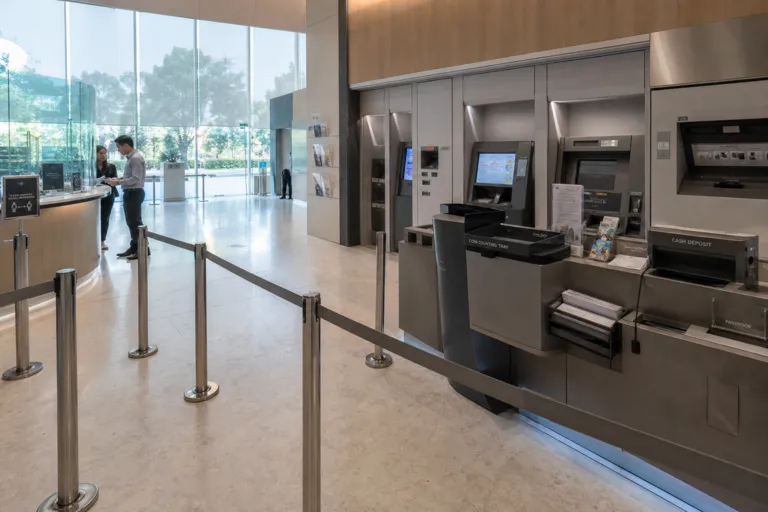
Cash and in-person banking remain part of resilience planning, not just nostalgia. A sponsored article in the ABA Banking Journal argues that as digital payments expand, cash remains critical for fairness, resilience, and national security, and it flags a “troubling trend” of merchants refusing to accept cash. It also notes that recent federal legislation in the U.S. reinforces protecting cash as a payment choice. This U.S.-focused context matters because it shows how policy can respond when market forces push too hard toward cashless norms. For audiences thinking about Singapore physical banking and cash access in 2026, the lesson is that “digital first” can coexist with explicit protections for consumer choice, especially during disruption or when digital channels fail.
Digital adoption does not automatically resolve inclusion and trust challenges. In the U.S., one compilation lists approximately 4.2% of Americans as unbanked, while another line in the same dataset says around 4.5% remain unbanked as of 2024. Meanwhile, digital banking’s promise is clear in market narratives: one industry report states that digital banking enables account opening, cashless transactions, and 24/7 access, helping unbanked populations integrate into the formal financial system, particularly where traditional infrastructure falls short in rural and underserved areas. Still, this hinges on confidence. The same report highlights cybersecurity and customer awareness as critical, warning that without confidence in data security, adoption may hesitate.
Even when digital usage is high, customer experience can be incomplete if it is purely functional. A 2026 digital banking statistics article reports that previously 62% of banking customers had an “effective” experience, but only 48% described it as “emotionally positive,” calling this a “relationship gap.” It also states that digital banks in the top 20% for customer advocacy scores grow their revenues 1.7x faster (global). The operational implication is simple: an omnichannel approach that preserves physical access and cash options can support trust and reduce friction for customers who do not fit the “all-digital” profile. That is the practical heart of “digital first, but not cashless,” and why safeguarding physical access remains part of the conversation around Singapore’s banking access and cash needs in 2026.
How dominant is digital banking globally right now?
What evidence shows people still want in-person branch access?
Why is cash still considered important in a digital-first economy?
What is the connection between digital transformation and fewer branches?
What does the discussion of Singapore physical banking cash access in 2026 take from these sources?