
Singapore’s construction sector is leaning into robotics as manpower pressures intensify and companies struggle to recruit and retain workers. The underlying workforce profile highlights why. As at December 2025, non-residents made up close to four in five of the sector’s 566,800 workers. In the same year, construction labourers were the top non-PMET job vacancy across all sectors, according to the Ministry of Manpower. Contractors also point to the total cost stack of hiring, including levies, accommodation, transport fees, salaries, and allowances. Against that backdrop, some firms see robotics not as a nice-to-have, but as a path to reduce manpower needs and make site work more attractive to locals.
Robots are already appearing on sites, but the rollout is uneven. Building and Construction Authority figures show that more than 25 types of robots have been deployed across about 60 projects, up from virtually no robots at construction sites in 2022. Even so, these deployments represent only about 5% of larger construction projects in Singapore. On the ground, early adopters describe why the technology matters. Painting subcontractor Seng Soon Huat Construction began using robots in 2025, and its founder Edmund Ng said one worker overseeing three painting robots can do work previously assigned to six. For firms facing tight labour conditions, that kind of shift is the core promise of construction automation.
Mandates, Not Momentum: How Public Tenders Are Forcing Change
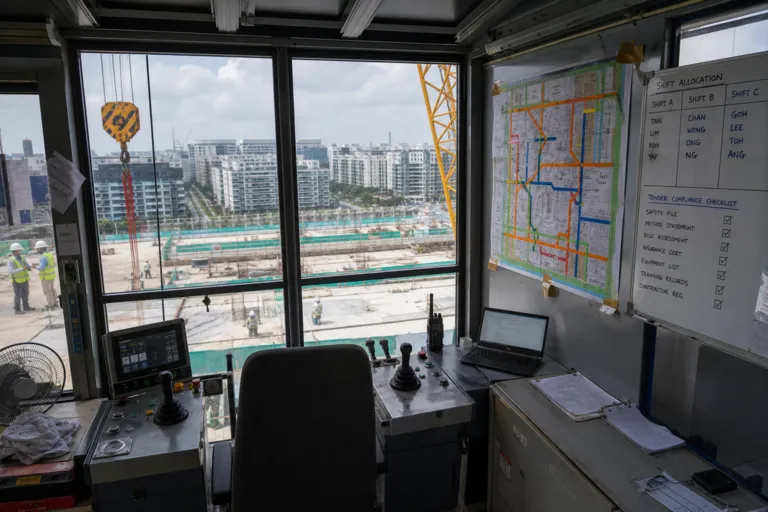
In Singapore, the most aggressive push is coming from the public sector, not from contractor-led demand. Since late 2025, every construction tender issued by JTC Corporation has required robots to be part of the bid. The Housing Board has also written robotics into 16 of the 31 Build-To-Order projects tendered since 2025. Most visibly for the Singapore construction robotics autonomous crane 2026 story, HDB is piloting an autonomous tower crane at Tengah, with results expected by Q4 2026. Supporters frame these moves as a way to boost safety and precision while cutting manpower needs. Critics argue the mandates can arrive before the business case is proven for smaller builders.
Cost and uncertainty remain the biggest speed bumps. Painting robots are cited as costing between S$80,000 and S$180,000, and some contractors say grants can take two to three years to disburse. Industry representatives also note that many firms hesitate to buy equipment without a track record, seeing robotics as expensive experiments rather than predictable productivity tools. The government’s Construction Industry Transformation Map sets a target of 80% of firms adopting advanced technologies including robotics by 2030, up from around 30% in 2023, and a S$1 billion BuildSG Transformation Fund launched in 2024 backs the push. But the timeline mismatch between mandated adoption and payback clarity is a practical challenge on live projects.
Singapore’s broader robotics ecosystem helps explain why construction is being pushed toward automation now. A separate national snapshot describes Singapore in 2026 as a country of 5.9 million people deploying 167 robots per 10,000 manufacturing workers, and notes large-scale automation at PSA International’s terminals, including automated quay cranes and autonomous guided vehicles, with over 500 robots across Tanjong Pagar and Pasir Panjang. That context matters, but construction has different risks, workflows, and site variability. The Tengah crane trial and the growing menu of site robots show direction, while the current 5% penetration rate in larger projects shows the distance still to travel.
Why is Singapore’s construction sector turning to robots now?
How widely are construction robots used in Singapore today?
What is happening in the Singapore construction robotics autonomous crane 2026 push?
Which agencies are mandating construction robots in tenders?
What is making contractors cautious about adopting robots?