
Singapore is expected to undergo rapid population ageing over the next two decades. By 2030, almost a million Singaporeans are expected to be aged 65 and above, and more seniors will need access to services to age in place. At the same time, the care burden is expected to grow, driven by the onset of frailty for some seniors and intensive care needs at the end of life for others. This is the context behind a push to make community care easier to navigate, so support is closer to home and less dependent on institutional care settings.
In recent years, the Ministry of Health (MOH) has invested in growing aged care capacity and piloting models that are more flexible for seniors and families. Under the Integrated Home and Day Care programme, seniors can receive care at home, at a nearby day care centre, or both, with packages customised for their needs. In parallel, MOH partnered with the Housing and Development Board (HDB) to create purpose-built Active Ageing Hubs in new estates as one-stop centres, offering services that can span active ageing, day care, rehabilitation, and even grocery delivery. The intent is to bring multiple touchpoints together so seniors have practical, nearby options rather than fragmented arrangements.
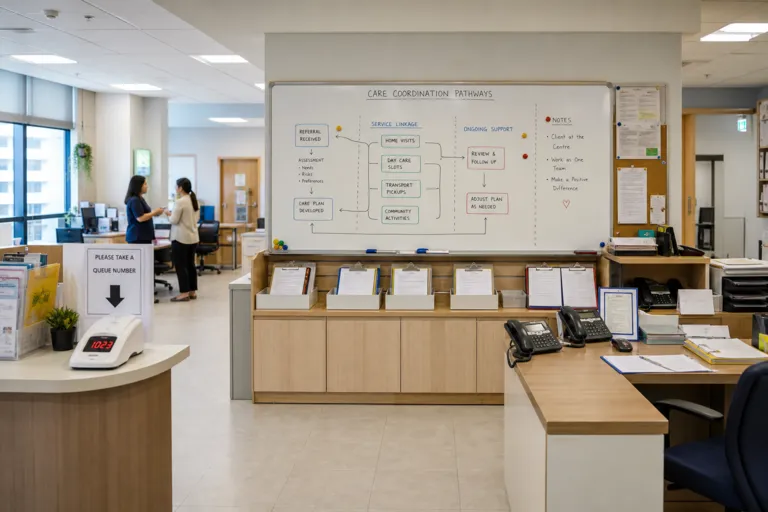
Inside the Integrated Provider Idea: One Sub-region, One Care Story
MOH has also signalled interest in making transitions between care settings smoother, with fewer delays and less administrative friction. In a Straits Times report, Health Minister Ong Ye Kung said seniors should be able to move from one care setting to another without too much delay or red tape, and MOH will look into this. One approach he cited was service providers in various sub-regions forming an integrated community care provider scheme to better coordinate how seniors in the sub-region are cared for. The same report also noted that enhanced home personal care services, integrated community care, and data sharing will support seniors ageing at home, starting in 2026—an important timing marker for how the model could show up in day-to-day experience.
Community hubs will remain a key operational anchor. Singapore’s Active Aging Centers (AACs) are described as a nationally coordinated and funded model that integrates health promotion, social engagement, and care coordination for older adults. Implementation research in Singapore, based on interviews with 21 AAC centre managers and staff, found the model conceptually strong and aligned with ageing-in-place goals. But it also surfaced real constraints, such as resource pressures, difficulty engaging underrepresented groups, and tensions between top-down design and frontline flexibility. On the ground, teams adopted strategies such as thematic approaches, senior volunteers, and culturally tailored outreach to improve engagement and sustainability.
Policy evolution points in the same direction: broader reach, more integration, and clearer coordination. A policy commentary on AACs noted that, under Healthier SG and Age Well SG reforms, AACs are being transformed from targeted social support points into population-wide health-social hubs, with a goal of reaching 80% of seniors by 2025. Read together with the 2026 start for more integrated community support cited by MOH, the Singapore Integrated Community Care Provider 2026 topic becomes less about a single new building and more about stitching existing parts into a simpler journey: upstream support, community connection, and coordinated health-social care that helps seniors remain at home for as long as possible.
Why is Singapore strengthening integrated community care for seniors?
What does an integrated community care provider scheme aim to change?
How do Active Aging Centers support ageing in place in Singapore?
What key milestone is linked to integrated community care starting in 2026?
What does the Singapore Integrated Community Care Provider 2026 topic mean in practice for seniors?