
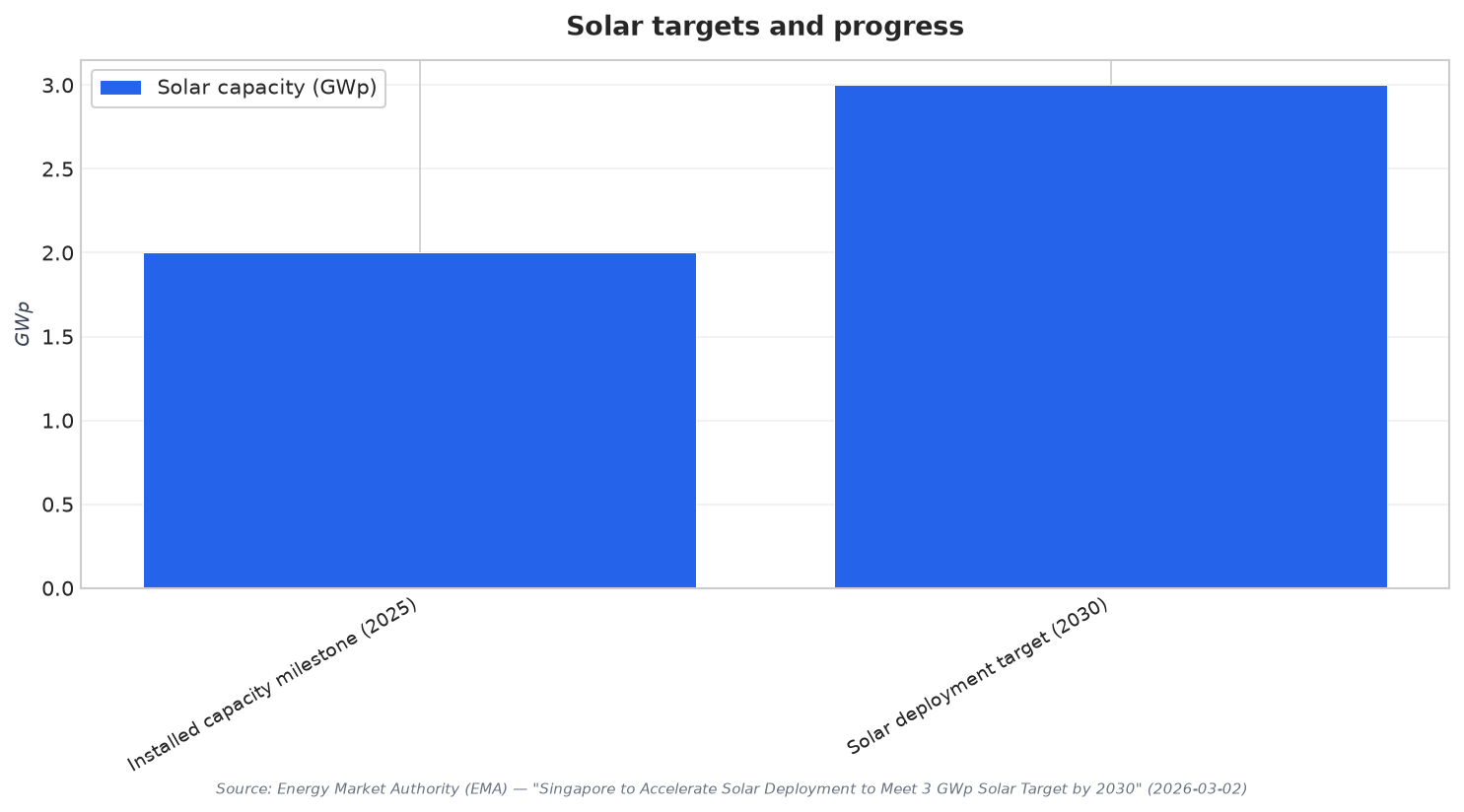
Singapore’s solar story is entering a new phase. The Energy Market Authority (EMA) said Singapore achieved 2 GWp of installed solar capacity in 2025, and the Government has raised the solar deployment target to 3 GWp by 2030. EMA also framed what 3 GWp means in daily terms: it can generate 2,800 GWh of electricity a year, which is sufficient to meet the annual electricity needs of around half a million households. The same reporting also notes that the new 3 GWp target could meet around 4% of Singapore’s total electricity demand in 2030, making the race for new surfaces—not just rooftops—central to the plan.
Rooftops still matter, but they are no longer the only frontier. EMA estimates that rooftop solar makes up more than 80% of total installed capacity today, and IndexBox similarly describes rooftop installations as approximately 80% of the nation’s installed solar capacity. To reach 3 GWp, EMA said it will ramp up deployment across more viable surfaces, tapping feasible rooftops, land, and water spaces, while exploring innovative deployments such as overhang solar that can serve as shelters and canopies at open-air car parks. This is also where the keyword topic—Singapore floating solar and offshore solar in 2026—becomes practical: water-based PV adds capacity without needing scarce land.
Floating and Offshore Solar: Turning Water Space Into Capacity
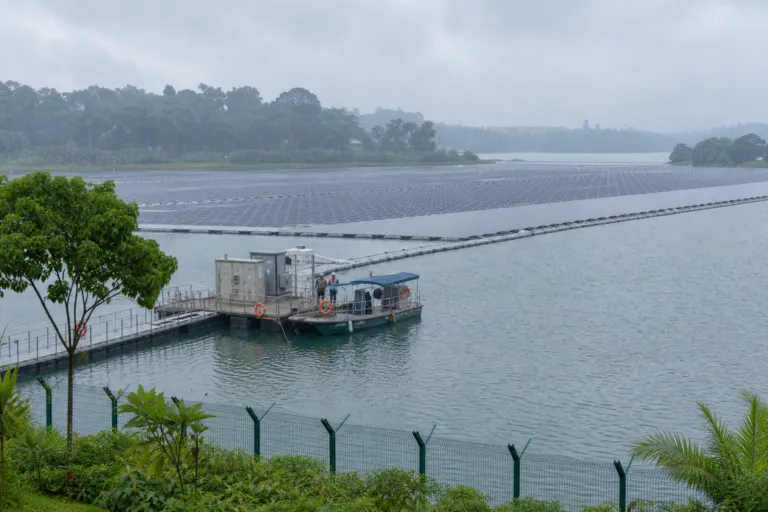
Floating solar is already part of Singapore’s installed mix, and more is queued up. Yahoo News Singapore reported that a floating solar farm planned for Lower Seletar Reservoir will begin construction in 2027 and, when completed, will generate at least 130 MWp—equal to 4.3% of Singapore’s 3 GWp target for 2030. IndexBox also points to project pipelines, citing plans for an 86 MWp floating solar facility on a local reservoir and a separate 150 MWp floating project on another reservoir. Separately, a solar manufacturing report notes a floating solar farm at Kranji Reservoir completed in 2021; it spans an area equivalent to 45 football fields and produces enough electricity to power about 16,000 four-room flats annually.
Offshore solar is part of the innovation toolkit too, even when details are still emerging. The same manufacturing report states that an offshore floating solar farm was deployed in the Straits of Johor by Sunseap Group, offering a proof point that PV can be pushed beyond reservoirs. EMA’s approach of deploying solar across rooftops, land, and water aligns with that trajectory. Singapore’s solar drive is also supported by enabling economics and programs: EMA linked the 2 GWp milestone to increasing cost-competitiveness and Government-led programmes such as SolarNova (Housing & Development Board), plus SolarRoof and SolarLand by JTC on industrial real estate. EMA also notes that owners of solar power systems can sell the renewable energy certificates (RECs) generated from solar energy for additional income.
Looking beyond 2030, the ceiling and the opportunity are both being mapped. Yahoo News Singapore cites a 2020 SERIS report estimating Singapore’s solar deployment potential could reach 8.6 GWp by 2050 and that this would account for about 10% of projected demand then. IndexBox similarly says EMA projected solar could meet about 10% of Singapore’s anticipated energy demand by 2050. Other commentary points to higher-outlook scenarios, but they are projections rather than policy targets; for example, Sunollo suggests solar could exceed the 3 GWp target, reaching 4–5 GWp through aggressive private rooftop deployment plus floating PV and façade BIPV. What is clear in 2026 is the direction of travel: Singapore is moving beyond the rooftop, using floating and offshore solar to widen the set of feasible surfaces on a land-constrained island.
What is Singapore’s solar target, and what does it mean in electricity output?
How much solar capacity had Singapore installed by 2025?
What new floating solar capacity is planned at Lower Seletar Reservoir?
How do floating and offshore solar fit the Singapore floating solar and offshore solar 2026 push?
Can solar system owners in Singapore earn extra income besides selling electricity?