

Singapore Exchange (SGX) and Nasdaq are building a dual-listing bridge that they brand the Global Listing Board (GLB). The concept is simple: one company, two exchanges, and a streamlined pathway to access U.S. market depth while keeping an Asian trading base. The collaboration was announced on 19 November 2025, and multiple reports place the go-live timeline around mid-2026. Bird & Bird describes it as a “direct and harmonised pathway” intended to let eligible companies simultaneously access growth capital and liquidity across the U.S. and Asia, using a simplified review process rather than two separate ones.
The key eligibility bar that repeats across sources is scale. Reuters reports that the GLB is aimed at firms with a market value of at least S$2 billion (US$1.55 billion), and The Business Times reiterates the minimum market capitalisation at S$2 billion. The same Business Times update adds a Singapore tranche requirement: 15% of the IPO value or S$75 million available for Singapore, whichever is higher. Together, these design choices show how Singapore is trying to combine Wall Street liquidity with local anchoring, without turning the Singapore side into an afterthought during the bookbuild.
Why Singapore Wants a Bridge—and What Could Hold It Back
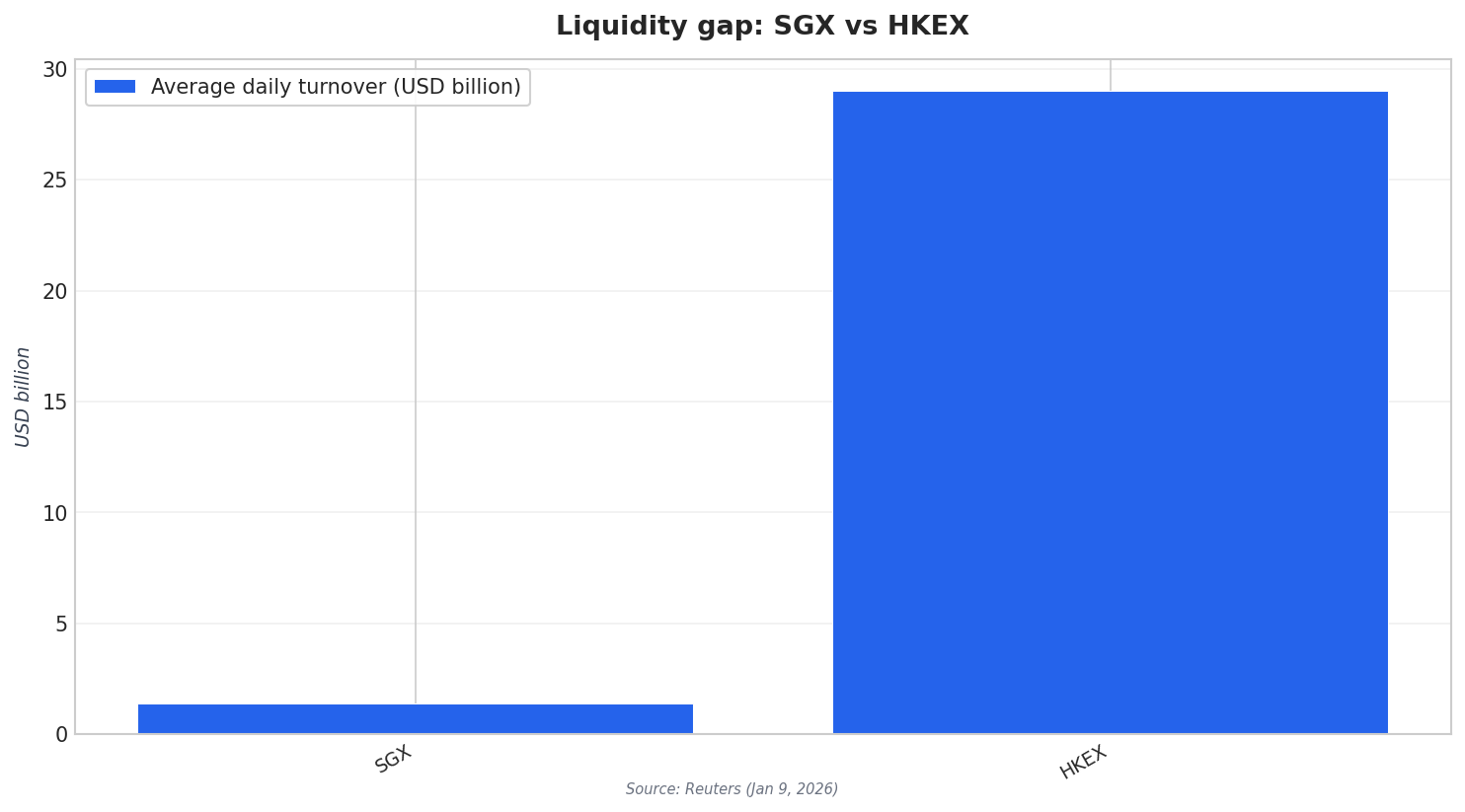
The policy goal is rooted in a long-running issue: low liquidity. Fortune cites average daily turnover on SGX at US$1.4 billion versus US$29 billion on the Hong Kong Stock Exchange (HKEX). Reuters reports a similar comparison, putting SGX average daily turnover at about US$1.39 billion in November versus US$29 billion in Hong Kong. Market participants quoted by Fortune argue that liquidity dynamics can become self-reinforcing, with higher volumes attracting more trading strategies and helping valuations, which then supports more IPO interest. Singapore has introduced steps to lift activity, including an almost US$4 billion fund, Reuters says, to support investment managers focused on small- and mid-cap equities.
The bridge is also positioned as a way to reduce process friction. Reuters notes that issuers can prepare a single prospectus for SGX and Nasdaq with a coordinated review replacing two separate processes. Quantum Accounting adds that disclosures such as financial information, MD&A, and risk factors will be standardised for submission to both markets, and that companies can prepare financials once using either IFRS or U.S. GAAP for use in both the United States and Singapore. The Straits Times reports that SGX and Nasdaq have been technology partners since 2003, and quotes Nasdaq vice-chairman Bob McCooey saying the GLB has drawn “a lot of interest” across sectors.
Even with interest, adoption is not guaranteed. Reuters flags two practical limits: thin liquidity and the high valuation requirement. Still, supporters see a two-way benefit. Fortune quotes EY’s Chan Yew Kiang saying the bridge could appeal to Southeast Asian companies that want to draw on the U.S.’s deep capital market while tapping “strong brand recognition” in Southeast Asia. Deloitte Southeast Asia’s Tay Hwee Ling adds in Fortune that U.S. firms might use the structure to extend trading hours beyond the close of U.S. markets and strengthen their presence in Southeast Asia. For readers tracking the Singapore SGX Global Listing Board Nasdaq 2026 moment, the real test will be whether early deal flow validates the streamlined promise.
When is the SGX-Nasdaq Global Listing Board expected to launch?
What is the minimum market capitalisation to use the dual-listing bridge?
How does the bridge reduce IPO complexity for issuers?
What Singapore allocation is required for a GLB IPO?
What does the Singapore SGX Global Listing Board Nasdaq 2026 initiative try to solve?