
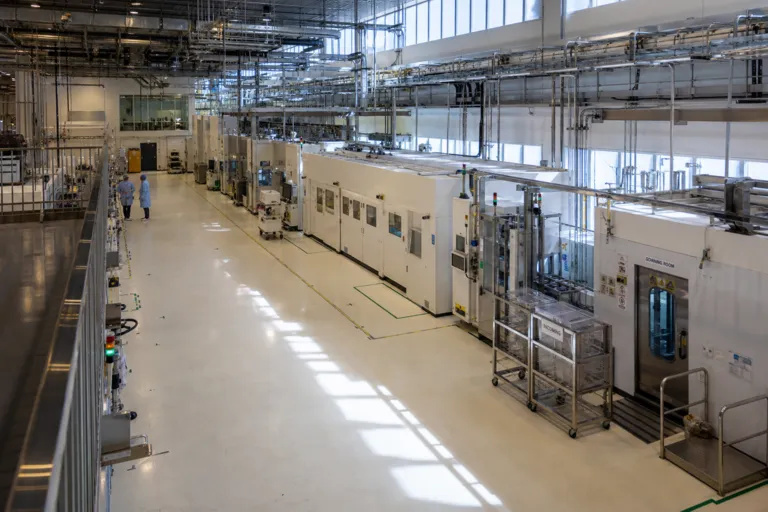
Advanced packaging is becoming a defining constraint and differentiator in AI-era semiconductors, and Singapore is leaning into that shift. Singapore’s Economic Development Board (EDB) says the AI boom has made memory chips “the star of the show,” and points to Micron’s HBM chip plant and United Microelectronics Corporation commencing local production as factors expected to increase Singapore’s chip capacity and output. Micron already has an unusually deep manufacturing footprint on the island: EDB notes that 98% of Micron’s NAND flash chips are produced in Singapore. In that context, the packaging build-out is not a standalone project. It is tied to a broader effort to keep memory manufacturing, packaging, and related capabilities clustered in one place.
Micron has described two linked moves in Singapore: an advanced packaging plant for high-bandwidth memory (HBM) and a major expansion of wafer manufacturing. CNBC reports Micron is building a US$7 billion advanced packaging plant in Singapore to produce HBM, a type of DRAM used in AI applications, and says the facility is on track to contribute meaningfully to Micron’s HBM supply in 2027. Separately, Micron committed approximately US$24 billion to expand wafer manufacturing operations in Singapore, adding 700,000 square feet of cleanroom space at an existing NAND manufacturing complex, with NAND production expected to start in the second half of 2028. Together, those timelines create a clear sequencing: meaningful HBM contribution in 2027, and additional NAND output from 2028.
Why Packaging Now Sits at the Heart of the Memory Race
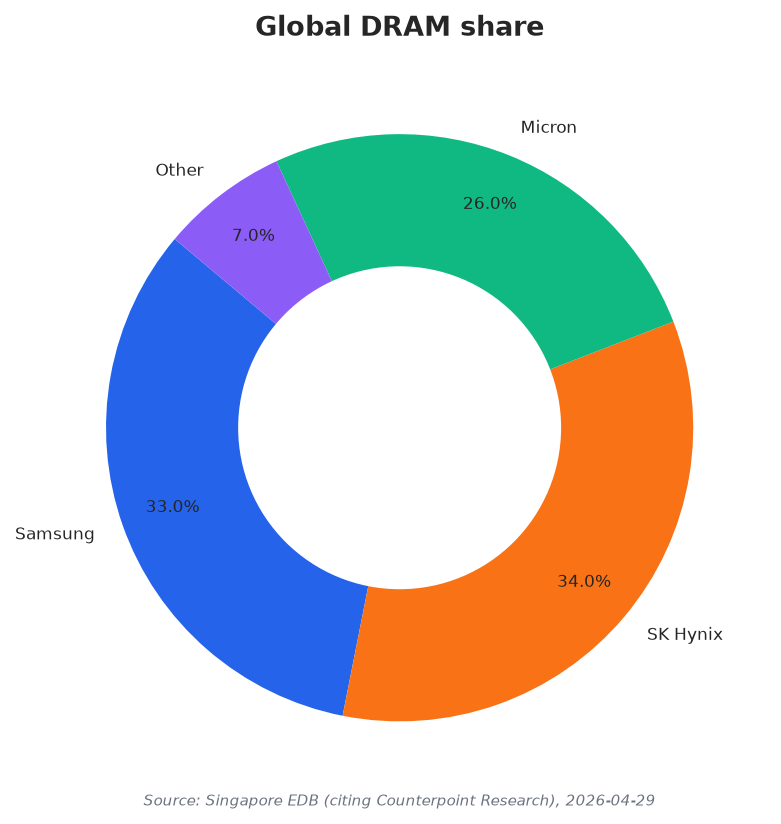
The memory market context helps explain why HBM packaging capacity matters. EDB cites Counterpoint Research showing Samsung, SK Hynix, and Micron Technology accounted for over 90% of global DRAM market share in Q3 2025, with shares listed as 33%, 34%, and 26% respectively, and notes their dominance in HBM is even more pronounced. Micron has also pushed back on earlier narratives about constrained ability to supply key AI customers: EDB reports Micron Chief Financial Officer Mark Murphy clarified the company has achieved mass production of HBM4 and has begun supplying customers. For the keyword topic—Singapore Micron HBM semiconductor packaging 2026—the takeaway is that the competitive battle is being fought not only on wafers, but also on packaging execution and ramps that meet customer timelines.
Jobs and ecosystem effects are being explicitly attached to these investments. CNBC reports the newly announced NAND expansion is set to generate about 1,600 jobs in fab engineering and operations, and says that follows the creation of about 1,400 new positions tied to the HBM plant. CFI.co frames this as “some 3,000 new positions on the island” when the US$7 billion HBM packaging facility is considered alongside the broader build-out. EDB argues the spillovers extend beyond headcount: it describes Micron as a “powerful magnet” for deep-tech enterprises in advanced packaging, materials science, automation, and AI manufacturing, and quotes Micron on co-locating R&D and manufacturing to strengthen collaboration, accelerate time-to-market, and deepen industry-academia partnerships.
The global AI investment wave is also being used as the backdrop for why memory and packaging demand remains central. CFI.co cites Futurum Group’s February aggregation of company guidance that puts combined 2026 capital spending by Microsoft, Alphabet, Amazon, Meta and Oracle at US$660 billion to US$690 billion, up from roughly US$380 billion in 2025. That spending is presented as translating into data centres, which require silicon including memory. Micron, for its part, says it expects synergies as HBM becomes part of its Singapore footprint, creating opportunities across NAND and DRAM production in the same manufacturing complex. The result is a Singapore strategy that is explicitly about packaging plus manufacturing scale, timed to the 2027 and 2028 ramps described in the sources.
What is Micron building in Singapore to support HBM used in AI?
How large is Micron’s wafer-manufacturing expansion in Singapore?
How many jobs are linked to Micron’s HBM and NAND projects in Singapore?
How does Singapore’s Micron HBM semiconductor packaging push in 2026 connect to the broader memory market?
What share of Micron’s NAND flash chips are produced in Singapore?