
Singapore’s carbon tax will almost double in 2026 to S$45 per tonne of greenhouse gas emissions. That change matters because large emitters include the power sector, and the tax puts a price on pollution that can flow into energy prices. A government spokesperson told The Straits Times that the total electricity and gas utility bill of an average four-room HDB flat will go up by about S$3 a month, assuming other market forces affecting quarterly tariffs remain constant and excluding GST. The same sources note near-term movement in tariffs can still be driven by fuel and energy costs, which can offset or amplify carbon-related impacts.
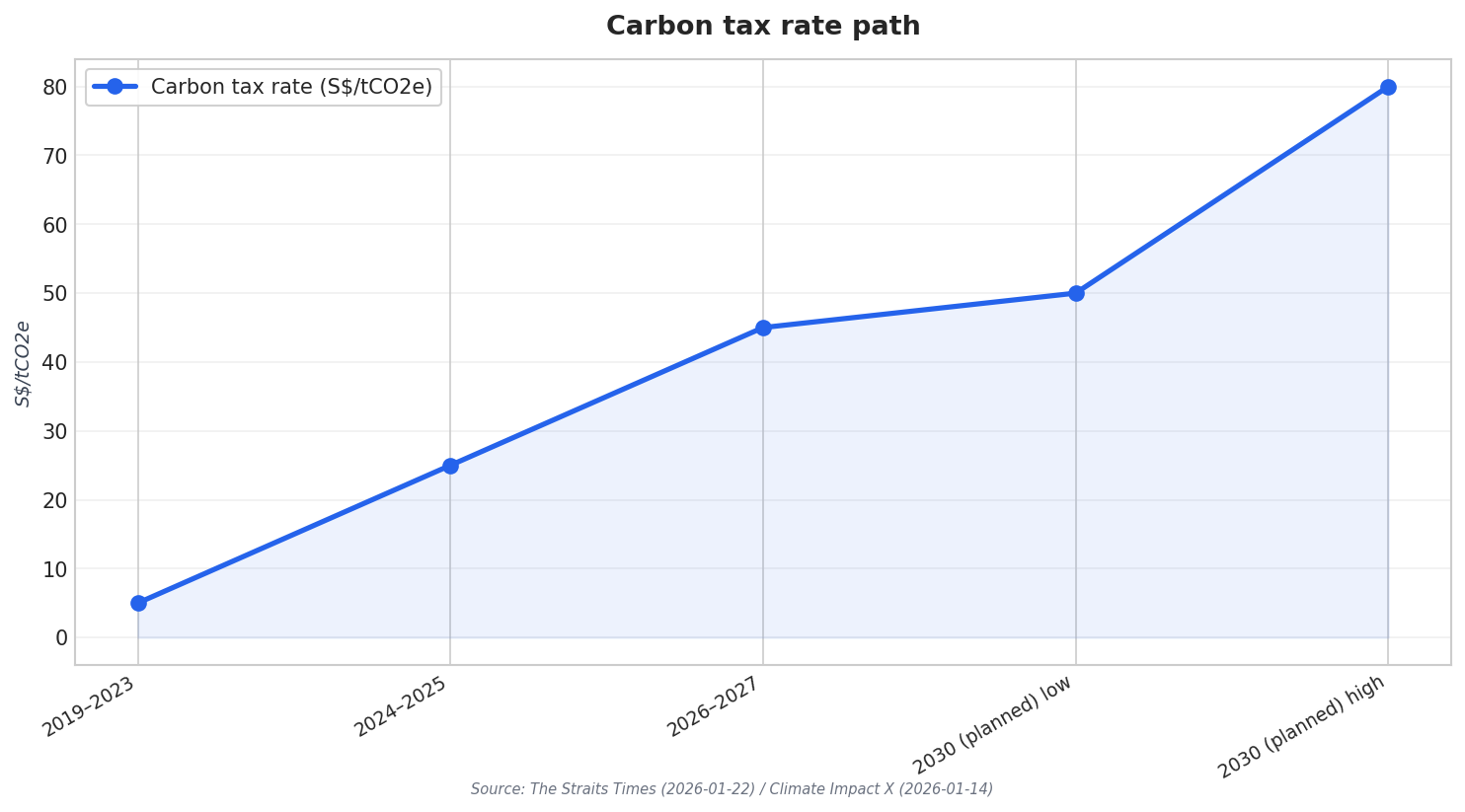
There is also near-term relief cited in the reporting. From January to March, electricity tariffs for homes were previously reported to decrease by 0.84 cent per kWh, while gas tariffs were set to fall by 0.67 cent per kWh. The spokesperson said this quarter’s decline in energy costs more than offset the impact of the carbon tax increase. Still, the tax trajectory is clear in the sources: after a S$5 rate between 2019 and 2023, the rate rose to S$25 a tonne in 2024 and 2025. During that S$25 period, the monthly utility bills of a typical four-room flat rose by around S$4.
Rebates Now, But a Longer Cost Curve Later
Policy support is part of the story as the carbon price rises. To help households defray utility expenses, the Government provides up to S$380 a year in U-Save rebates, and the spokesperson said double the amount has been given in recent years to support living expenses amid higher inflation and to cushion the impact of increases in carbon tax and water prices. In January, more than 950,000 Singaporean households in HDB flats will receive up to S$190 in U-Save rebates. At the same time, a climate observer, Melissa Low, cautioned that while residents can expect rebates to help them, these may not cover the full increase in the long term.
For businesses, the cost question goes beyond the direct tax bill paid by major emitters. The Business Times reports that major emitters such as power and manufacturing companies have to pay S$45 per tonne this and next year, up from S$25 per tonne over the last two years. Savills Singapore frames the 1 January 2026 hike to S$45 per tonne as a structural overhead that flows into the electricity bills of commercial entities. It says that for most businesses, this translates into a cumulative electricity cost increase of roughly 8% to 12% by 2030, positioning energy efficiency as an operating cost issue through 2030.
The longer runway is also explicitly stated in multiple sources. The S$45 tax rate is described as being in place until 2027, with a view to reaching between S$50 and S$80 a tonne by 2030. Economist David Broadstock of The Lantau Group said the planned increases may nearly double the impact on utility bills in 2030, and added that the carbon tax both raises money to deal with pollution impacts and increases the price of energy to discourage consumption where it can be avoided. In parallel, MSE links the carbon tax to broader national efforts, stating that Singapore announced a 2035 emissions level of between 45 and 50 MtCO2e and a 2030 level of around 60 MtCO2e, aligned with a commitment to achieve net-zero emissions by 2050.
What does the Singapore carbon tax change in 2026 mean at S$45 per tonne?
How did the carbon tax affect typical household utility bills before 2026?
What rebates are available to cushion higher utility expenses?
How might the higher carbon tax affect business electricity costs over time?
Where do sources say Singapore’s carbon tax rate is headed after 2026?