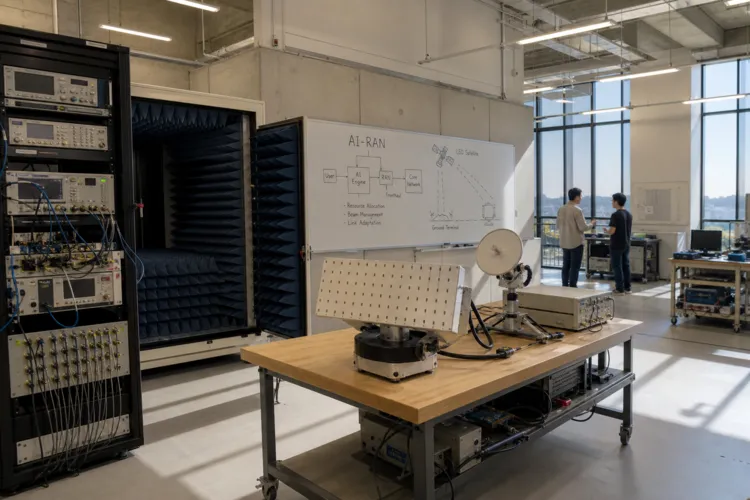

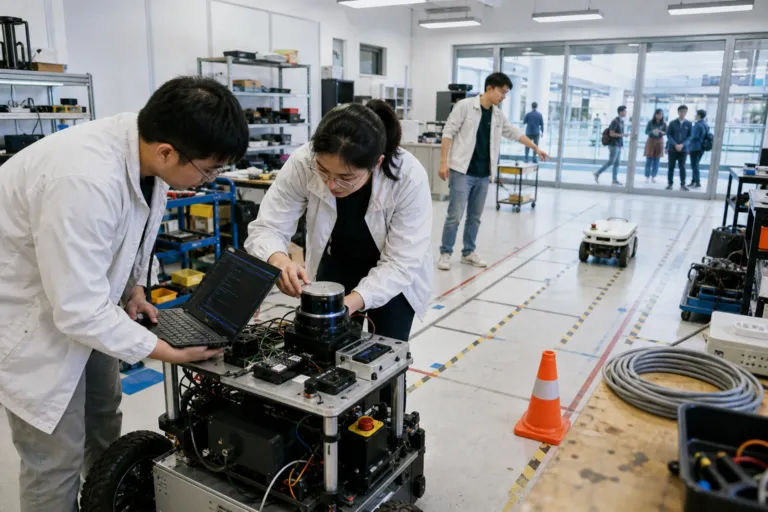
Nvidia will open a new research centre in Singapore focused on advancing embodied AI and improving the efficiency of AI computing infrastructure, according to CNBC and Singapore government statements. It will be Nvidia’s first research hub in Singapore and its second such presence in the Asia Pacific, as reported by CNBC. The announcement was made on the opening day of Singapore’s ATxSummit, where the conference placed significant focus on AI. The lab is positioned to work alongside university researchers, industry partners, and government agencies, linking research goals to real operational environments rather than keeping development isolated inside a single corporate lab.
The timing is reinforced by parallel national moves that emphasize deployment. Singapore said it will launch a multi-operator robot testbed later in 2026 to help private companies co-design, deploy, test, and validate commercially viable AI robotics services, per CNBC. Early participants expected for the testbed include Certis, DHL, Grab, and QuikBot, according to CNBC and The Edge Singapore. In addition, the government will work with robotics companies including Slamtec, Unitree, and QuikBot through a new Center for Intelligent Robotics to trial use cases such as food and parcel delivery, cleaning, and security patrolling. These are framed as applications meant to complement existing human operations.
What “Embodied AI” Means for Singapore’s Next Wave of Pilots
“Embodied AI” is described as AI systems that interact with the physical world, including robots, autonomous vehicles, drones, and other hardware linked to AI systems. CNBC reports Singapore appears to be placing specific focus on this category, which it describes as a key next frontier in AI development. For the ecosystem, this matters because embodied AI is not just about models; it is about integrating perception, control, and real-world constraints in environments where safety, reliability, and interoperability shape adoption. A multi-operator testbed also implies cross-vendor trials, allowing different companies’ systems to be evaluated under shared conditions.
From an ecosystem lens, the research hub and testbed align around two practical bottlenecks: validating physical deployments and managing infrastructure costs. Nvidia’s lab focus includes improving AI infrastructure efficiency, while Singapore’s testbed is explicitly set up to co-design, test, and validate commercially viable services. That pairing can shorten the path from prototype to pilot by giving researchers and companies a structured place to trial delivery, cleaning, and security patrolling. It also connects private-sector logistics and facilities use cases—represented by firms like DHL, Grab, and Certis—to government-supported experimentation that can be repeated and compared across operators.
Zooming out, Singapore’s dealmaking narrative adds context. Asia Tech Review reported that Singapore brokered deals with OpenAI, Google, and Nvidia as it bids to be a global AI deployment hub. It also noted Singapore’s constraints, citing a population of 6 million and less than 800 square kilometres of land, which increases the premium on dense, well-coordinated pilots. In this setting, the Singapore NVIDIA AI research hub is less about a one-off announcement and more about signaling a long-term research presence tied to deployment pathways. Observers can watch for technical outputs from the lab and for early pilot results from the testbed as the ecosystem matures.
What is Nvidia’s new AI lab in Singapore focused on?
How many Nvidia research hubs does CNBC say this represents in the region?
What is the multi-operator robot testbed and who is expected to participate?
Which use cases will Singapore trial through the Center for Intelligent Robotics?
What does the Singapore NVIDIA AI research hub signal for the local ecosystem?