
Decarbonising air travel is difficult because most aviation emissions come from international flights, which are challenging to abate. Singapore’s approach uses Sustainable Aviation Fuel (SAF), which the Civil Aviation Authority of Singapore (CAAS) describes as a drop-in fuel that can reduce carbon dioxide emissions by up to 80%. IATA expects SAF to contribute around 65% of the emissions reduction needed to achieve net zero by 2050. To help scale SAF use, CAAS has set a national SAF uplift target that starts at 1% in 2027, with an ambition to raise it to 3%-5% by 2030 depending on global developments and SAF availability.
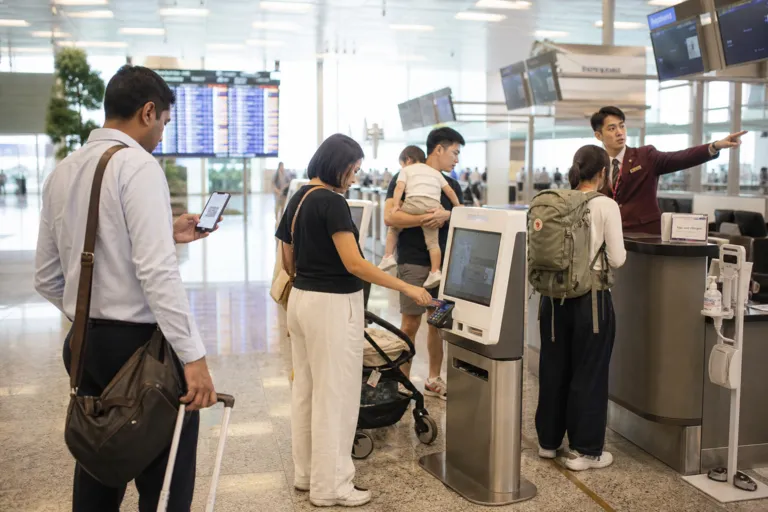
The policy instrument passengers will feel most directly is the Singapore sustainable aviation fuel levy, which CAAS ties to flights departing Singapore. CAAS states that a levy will be collected for flights departing Singapore from 1 January 2027, and it applies to tickets or services sold from 1 October 2026. Other reporting on the levy’s rollout describes a start on 1 October 2026 for flights originating in Singapore, with applicability to tickets or services sold from 1 April 2026. What stays consistent across CAAS communications is the design: the levy is collected on departures, it varies by destination band and travel class, and it is intended to fund SAF rather than operate as a general revenue measure.
What You Pay and Where the Money Goes
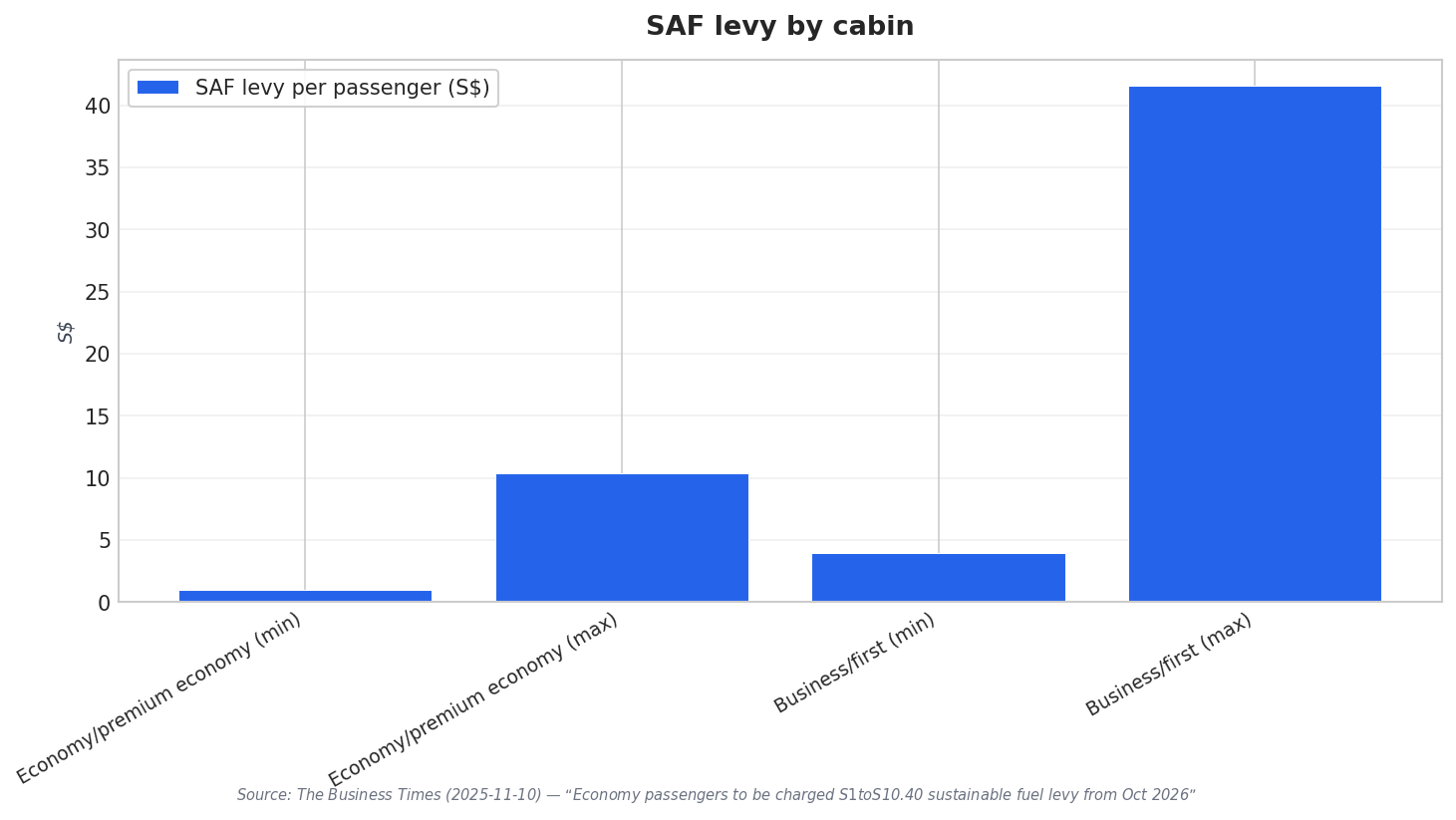
For Origin-Destination passengers, CAAS says the per-passenger levy varies by the destination’s geographical band and cabin class, split between economy cabins (economy and premium economy) and premium cabins (business and first). Reported rates range from S$1 to S$10.40 for economy class, and from S$4 to S$41.60 for business and first class, with the highest amount cited for premium cabin flights to the Americas at S$41.60. Cargo is also covered. The cargo levy is reported as S$0.01 to S$0.15 per kilogram, varying by the destination’s geographical band. Transit passengers passing through Singapore are stated as not facing the levy, and CAAS has said the levy must be displayed as a distinct line item in the air ticket or cargo contract.
The proceeds are ring-fenced. CAAS says the SAF levy will go into a SAF Fund, which procures SAF and SAF Environmental Attributes (EAs) and covers related administrative costs. CAAS defines SAF EAs as representing the carbon benefits arising from the difference in lifecycle carbon dioxide emissions between SAF and conventional jet fuel. The central procurement model is led by Singapore Sustainable Aviation Fuel Company Ltd. (SAFCo), launched by CAAS in October 2025. CAAS says SAFCo will manage levy collection, aggregate demand to reap economies of scale when centrally procuring SAF and SAF EAs, and also allow businesses and organisations to buy SAF voluntarily through the same process.
Administration also includes tracking and claims. CAAS says the SAF EAs procured will be registered in a SAF Registry and allocated to aircraft operators and other companies, and that these EAs can be used to claim emissions reductions under ICAO’s CORSIA or for sustainability reporting. In parallel, CAAS frames the levy as part of a broader push to build a scalable and integrated SAF ecosystem, including encouraging investments in SAF production and SAF-related carbon markets in Singapore and the region. CAAS also points to airline fleet renewal and operational improvements, including modernising fleets with newer, more fuel-efficient aircraft and improving operations to reduce fuel burn. Together, these measures aim to progressively decarbonise airline operations while keeping the levy structured by distance and cabin.
When does Singapore’s sustainable aviation fuel levy start applying to tickets and departures?
How much is the levy for passengers on flights originating from Singapore?
Does the levy apply to cargo, and how is it calculated?
Where does the levy money go?
What role do SAF Environmental Attributes play in the policy?