
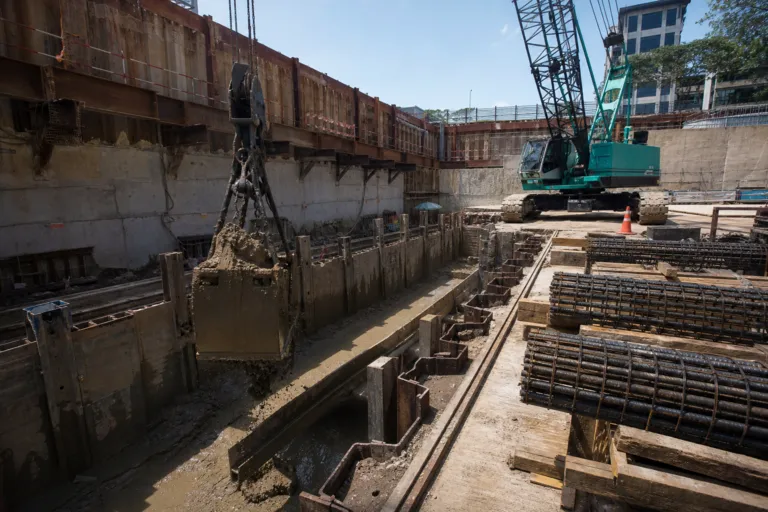
Singapore’s push for safer and more material-efficient underground construction took a clear step forward in 2026. At the Singapore Institute of Technology (SIT) Construction Technology Innovation Laboratory (CTIL) Technical Seminar 2026, National Development Minister Chee Hong Tat launched two moves at once: a new research programme for sustainable construction technology and new guidelines to enhance the construction quality of diaphragm walls. This matters because diaphragm walls are a common earth-retaining solution for very deep excavations, including major transport works, and they sit within the broader Earth Retaining and Stabilising Structures (ERSS) submission category used for BCA processes.
For practitioners, the practical context is the existing submission and approval ecosystem. BCA’s structural plan application guidance positions the Qualified Person (QP) for structural works as responsible for securing approval for structural plans and a building permit before construction begins, under the Building Control Act and related regulations. Diaphragm walls are one of several ERSS types used to retain earth and support excavations, alongside systems such as sheet piles and secant piles. As industry guides note, ERSS work can also involve additional approvals where projects adjoin sensitive infrastructure, and higher-risk geotechnical building works may require an Independent Checker under BCA regulations.
Why 2026 Focused on Quality, Verification, and Material Use
The diaphragm wall quality guidelines did not appear in isolation. They were launched alongside a three-year S$30.4 million research programme aimed at cutting carbon emissions from construction, improving material efficiency, and developing technologies applicable to commercial buildings and infrastructure projects. The initiative brings together SIT, A*STAR, construction firm Woh Hup, and seven other industry partners. It is structured around seven projects spanning sustainable construction materials, underground structural systems, and reuse of building components, which collectively signal a pipeline of tools and methods intended to support safer delivery with less waste.
Several research workstreams connect directly to how underground structural systems could be designed, checked, and built with tighter control. The programme includes work on lightweight earth-retaining structures and composite steel-fibre-reinforced concrete slabs for deep foundations, with the stated intent to improve construction efficiency while reducing material requirements and maintenance needs. It also includes digital systems to verify and trace reinforcing steel through construction supply chains, and AI-assisted design tools for steel-concrete composite flooring systems that help engineers evaluate structural arrangements, material consumption, and construction costs during design. A separate effort will build a digital platform to manage recovery and reuse of structural steel from buildings.
These moves align with a broader policy direction, but it is important to keep the claims precise. The consortium aims for reductions of up to 40% in embodied carbon through selected technologies compared with conventional approaches, and this is explicitly a research target rather than a reduction already demonstrated across completed projects. Earlier work linked to the CTIL partnership, established in January 2021, produced ultra-low-carbon concrete technologies that were used in Singapore residential developments including Copen Grand and Lumina Grand, as well as the Union Square project. Against that backdrop, the 2026 diaphragm wall quality guidelines can be read as part of Singapore’s evolving set of expectations for better-controlled underground construction.
What are the Singapore diaphragm wall guidelines for 2026 trying to improve?
How does a diaphragm wall fit into Singapore’s ERSS process?
What is the scale and duration of the sustainable construction research programme launched in 2026?
What carbon outcome is the 2026 research consortium aiming for?