
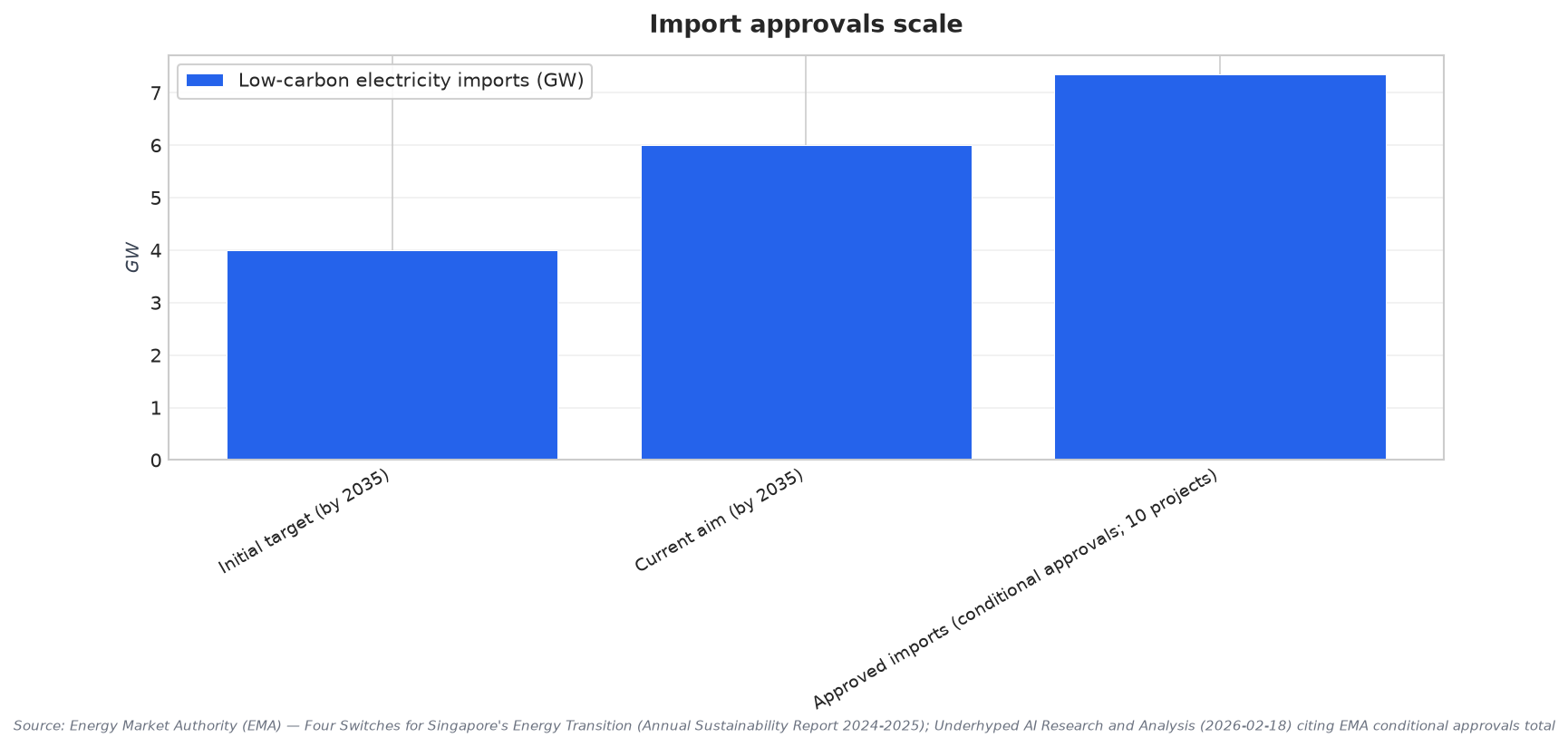
Singapore’s electricity-import strategy is moving from trial-scale cross-border flows to a multi-project pipeline designed to strengthen energy security and decarbonisation. The Energy Market Authority (EMA) says Singapore now aims to import around 6 GW of low-carbon electricity by 2035, up from an initial 4 GW target. Conditional Approvals and Conditional Licences have been granted to import projects from Australia, Cambodia, Indonesia and Vietnam. Independent analysis also notes a bigger stack of conditional approvals: ten import projects totalling 7.35 GW. At the same time, project timelines matter. Commentary on the pipeline stresses that conditional approvals may not translate into large-scale physical deliveries until the late 2020s, with the largest capacity arriving in the early 2030s.
Cost and emissions outcomes are central to why Singapore is leaning into interconnections and imports. Ember reports Singapore could turn to cleaner alternatives such as imported solar, which could be as low as 13.5 US cents/kWh. That compares with an electricity tariff of around 22.4 US cents/kWh and the cost of domestic electricity production of around 19.4 US cents/kWh. Ember also outlines a scenario where doubling the target for renewable import capacity from around 4.2 GW to 8.1 GW by 2035 can reduce 52% to 58% of Singapore’s per-capita power sector emissions by 2035. It adds a system mix implication: the share of electricity from gas could drop from 92% in 2022 to 61% by 2035 as renewables are increasingly imported to meet demand.
Conditional Approvals Are Rising, but Delivery Depends on Cables, PPAs, and Financing
New 2026 announcements show how Singapore’s cross-border buildout is expanding through Malaysia, alongside other approved corridors. In Johor, Singapore granted conditional approval to Sembcorp Utilities Pte Ltd to import about 300 MW from a project that includes floating solar with 2.2 GW of peak capacity and as much as 4.3 GWh of battery storage, with operations expected to begin in 2029. Separately, Southern Solar Alliance Pte Ltd received approval to import 600 MW from a solar and battery facility in Malaysia, also targeting commercial operations around 2029. EMA said these companies must obtain approvals from relevant jurisdictions, conclude power purchase agreements with buyers, secure sufficient financing, and reach project milestones to get to financial close. Sembcorp also stated the project is designed to meet energy demand in both Singapore and Malaysia and will leverage existing and future subsea interconnection infrastructure to facilitate cross-border power flows.
Singapore’s evolving import plan also sits alongside earlier regional grid trials and near-term renewable import volumes. Wikipedia summarises trials including a two-year trial to import 100 MW from Peninsular Malaysia, 100 MW from Laos via the Lao PDR-Thailand-Malaysia-Singapore Power Integration Project (LTMS-PIP) under the ASEAN Power Grid Project, and 100 MW equivalent of non-intermittent electricity from a solar farm in Pulau Bulan, Indonesia. Ember reports Singapore is importing up to 100 MW of hydropower from Lao PDR until 2024, with a planned two-to-five year extension that would raise the total renewables volume to 300 MW. It also notes approvals to import 2 GW of renewable energy from Indonesia, 1 GW from Cambodia, and 1.2 GW from Viet Nam by 2035, reinforcing that a portfolio approach—not a single link—is shaping the regional grid pathway.
The biggest upside of Singapore electricity imports in a 2026 regional grid context is that approvals are becoming a platform for larger market-building ambitions, not just supply contracts. Underhyped AI Research and Analysis cites an estimate from Rystad Energy that ASEAN could unlock 25 GW of renewable energy capacity and over USD 40 billion in investment through Singapore-anchored interconnections. However, it also flags the practical gap between regulatory approvals and physical infrastructure, measured in years. Wikipedia notes one example of long-distance ambition: Sun Cable was granted conditional approval on 22 October 2024 to import 1.75 GW of solar-generated electricity from Australia’s Northern Territory. Taken together, the figures point to accelerating conditional approvals while the decisive test remains execution: cables, interconnections, project finance, and contracts that convert approved capacity into dependable cross-border power flows.
What is Singapore’s import target for low-carbon electricity by 2035?
How much electricity-import capacity has received conditional approvals across projects?
What new Malaysia-to-Singapore import approvals were announced for Johor projects?
How does imported solar pricing compare with Singapore’s electricity tariff and domestic production costs in the cited analysis?
In the Singapore electricity imports 2026 regional grid story, when is large-scale imported power expected to arrive?