
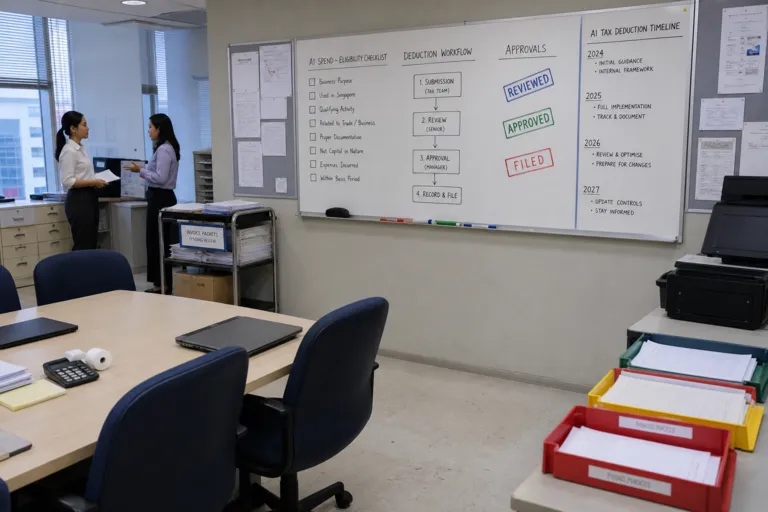
Budget 2026 introduced a clear, time-boxed incentive for AI adoption under the Enterprise Innovation Scheme (EIS). The measure lets companies claim a 400% tax deduction on qualifying AI spending, capped at S$50,000 per Year of Assessment, and it applies only to YA2027 and YA2028. Put another way, S$50,000 of qualifying AI expenditure can translate into a S$200,000 tax deduction. This is the central claim business owners should focus on when planning AI projects tied to Singapore’s Budget 2026 changes.
The EIS itself has been around since Budget 2023 and runs from YA2024 to YA2028. It already provided 400% deductions on qualifying activities such as research and development, intellectual property registration and acquisition, and approved training. Budget 2026 enhanced the scheme by adding AI expenditure as a new qualifying activity, with its own separate S$50,000 cap per Year of Assessment for YA2027 and YA2028. For many teams, the operational takeaway is straightforward: the AI category is a distinct bucket, so it should be tracked cleanly with its own documentation and vendor scopes.
What Counts as Qualifying AI Spend (and What Does Not)
IRAS has defined what qualifies under the EIS AI category on its Enterprise Innovation Scheme page (last updated 23 September 2026). Qualifying AI expenditure includes subscriptions to, or licensing from another person of, an AI system, plus subscriptions to, or acquisition or licensing from another person of, a qualifying AI business service. IRAS lists examples such as online platform provision, system development, consultancy and strategy, system engineering and compliance, and system-related training. It excludes spending on physical infrastructure or hardware like servers, storage devices, and computing equipment, and it also excludes any expenditure subsidised by a Government grant or subsidy.
There are also boundaries that affect who benefits. The AI category does not have a cash payout option, unlike other EIS activities that may allow converting part of the spend into cash. As a result, this is structured as a tax deduction and is most relevant when a company can actually use the deduction against taxable income. Several common errors show up in guidance around the scheme: missing the S$50,000 annual cap, expecting the cash payout option to apply to AI, mixing AI project costs with normal software or IT costs, and keeping no project notes or vendor scope documents to support what was delivered.
Seen in the wider Budget 2026 push, the EIS enhancement sits alongside other AI initiatives described publicly. Singapore’s National AI Impact Programme is positioned to support 10,000 enterprises and 100,000 workers over three years. In the same environment, Singapore’s data centre planning also signals how AI workloads are being shaped: a call that closed 31 March 2026 offered at least 200MW of new capacity, conditional on facilities running on at least 50% renewable or low-carbon power. For business planning under the Singapore Enterprise Innovation Scheme AI 2026 topic, the practical approach is to map specific AI subscriptions and services to IRAS guidance and keep evidence trails that match the claim.
What exactly did Budget 2026 add to the Enterprise Innovation Scheme for AI?
How much deduction can S$50,000 of qualifying AI spend generate?
What spending qualifies under IRAS guidance for the EIS AI category?
What does IRAS exclude from qualifying AI expenditure under the scheme?
How does the Singapore Enterprise Innovation Scheme AI 2026 update affect cash payouts?