
Singapore’s Land Transport Authority (LTA) has pushed the first stage of the Jurong Region Line (JRL) to mid-2028. Acting Minister for Transport Jeffrey Siow said the Stage 1 completion will be delayed by six months, compared with the earlier projection of around the end of 2027. The JRL is meant to serve the western part of Singapore, including Tengah and the Jurong Innovation District. Over time, the project’s public timelines have shifted. The line was previously estimated to open in stages between 2026 and 2028, and in 2021 its completion was pushed back by a year to 2029 due to the Covid-19 pandemic.
What matters to commuters is not just the headline date, but what the delay signals about construction sequencing and risk. LTA said it has worked with contractors to increase construction capacity. It cited increasing manpower and equipment deployment to increase the pace of works. Even with those efforts, the agency said more time is needed to complete certain complex works safely. This puts the focus on safety and constructability rather than a single bottleneck. For those tracking the Jurong Region Line delay 2028 storyline, the official explanation is clear: the schedule change is tied to complex, safety-sensitive works that require more time than first planned.
What LTA Says Is Driving the Pushback
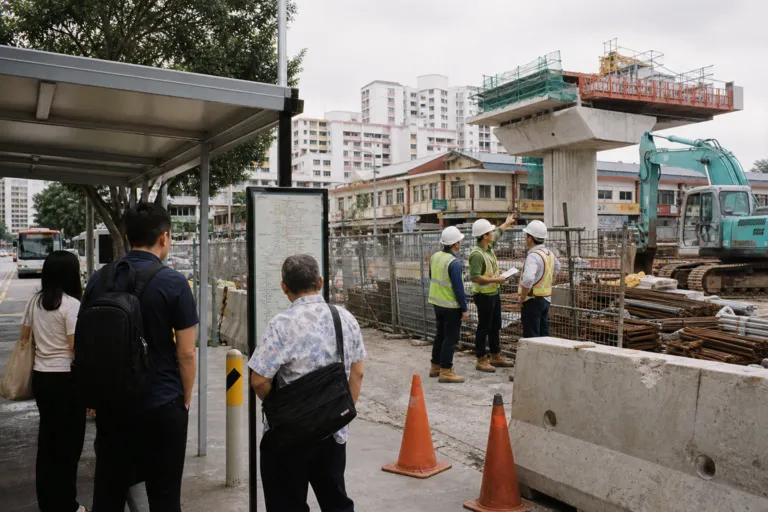
LTA provided specific examples of why the works are taking longer. One is the construction of a viaduct over the Pan Island Expressway, which it said can only be carried out during overnight road closures due to safety concerns. Another example is a viaduct over a 25-metre-wide canal where ground reinforcement is needed to ensure stability. These details help explain why “adding capacity” is not always enough to compress a programme. If work windows are constrained to overnight closures, there are natural limits on daily productivity. And if ground reinforcement is required to maintain stability, the engineering sequence itself can force a longer timeline.
In the meantime, LTA said it will introduce interim shuttle bus services between the areas served by the JRL’s first stage from the end of 2027. It also said it will continue to adjust or add bus services where needed. This is a practical bridge for residents and workers expecting new rail connections in the west, even if it is not a one-for-one replacement for train operations. The JRL is designed to serve districts including Tengah and the Jurong Innovation District, so interim buses are positioned as a stopgap to support mobility while construction continues toward the mid-2028 opening.
Looking beyond Stage 1, LTA did not confirm whether the six-month delay will extend the overall completion date for the entire line. Instead, an LTA spokesperson said it will do its best to open the second and third stages as soon as possible and will provide further updates on the opening dates as works progress. Separately, LTA announced a new station on the JRL, designated JS2A, between Choa Chu Kang West (JS2) and Tengah (JS3). Civil construction has begun, and it is targeted to open in the mid-2030s with surrounding developments. With this, LTA said the JRL will have 25 stations in total.
Why was JRL Stage 1 pushed back to mid-2028?
How long is the Stage 1 delay compared with earlier expectations?
Will there be any transport support before the line opens?
Does the Jurong Region Line delay to 2028 affect later stages too?
What is JS2A, and when is it expected to open?