
Singapore’s car market entered 2026 with COE premiums already anchored in six-figure territory. In October 2025, Sgcarmart described 2025’s climb as “relentless” and noted that, averaged across July to September, Categories A, B and E all rose sharply versus the prior quarter. Category B and open Category E rose by 7.1% and 7.3% respectively, while Category A increased 6.3%. In the 17 September 2025 bidding round, Category A hit $119,003, an all-time high, while Category B was closing in on $140,000 and Category E was already at that level. That backdrop matters, because it set expectations before the new year even began.
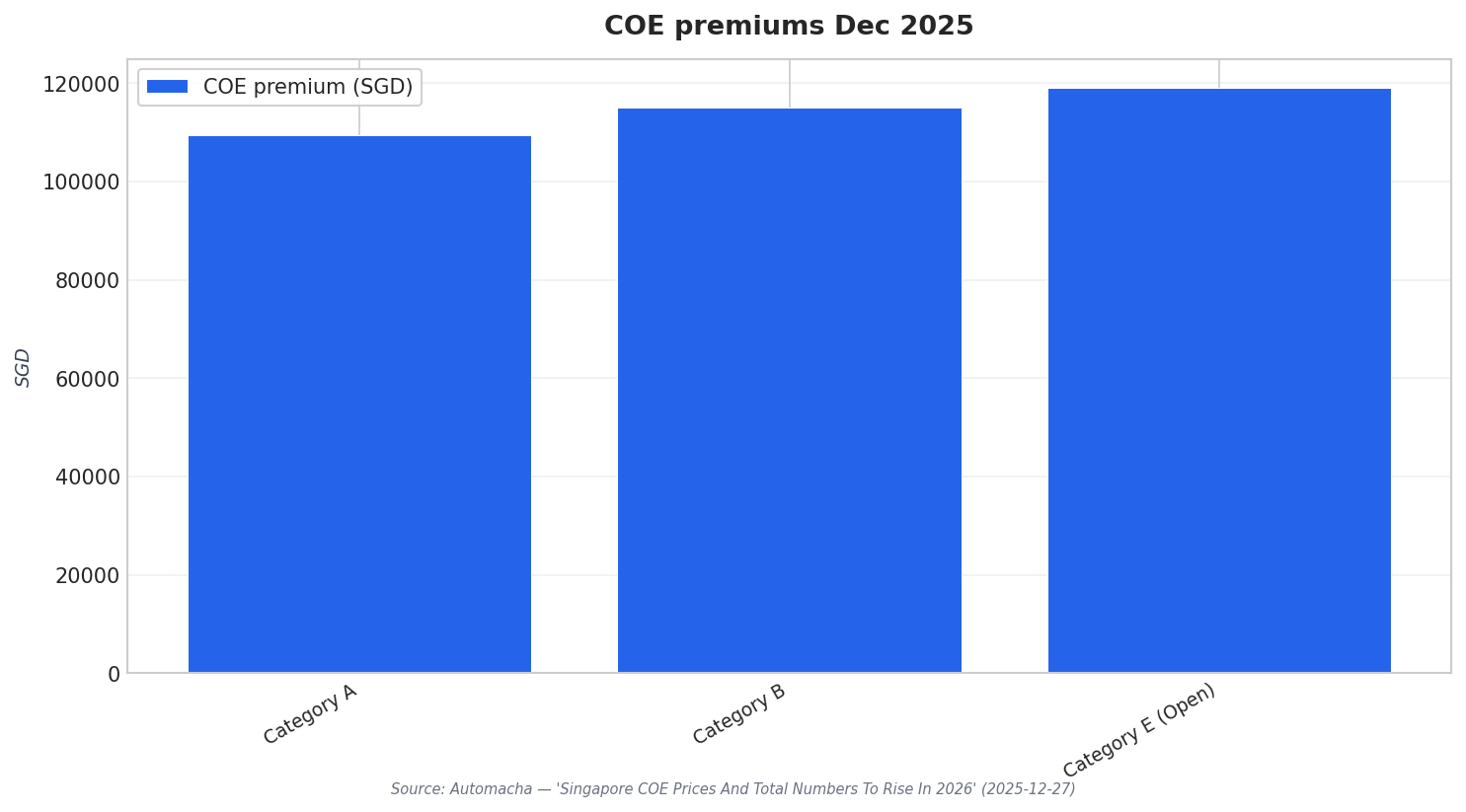
By late 2025, premiums still looked stretched. Automacha listed final 2025 bidding prices of $109,501 for Category A, $115,102 for Category B, and $119,000 for Category E. At the same time, commentary across sources converged on demand staying firm rather than fading. The Business Times reported that passenger car COE supply may grow some 20% in 2026, but premiums may not fall significantly, because demand remains supported by EV buyers and private-hire car (PHC) fleets. Automotive consultant Say Kwee Neng was quoted saying COEs may not trend downwards significantly in 2026. In this climate, the six-digit “benchmark” for Category A became a reference point cited by Automacha, reinforcing buyer acceptance of high levels.
Why Demand Can Outrun Extra Supply in 2026
Several demand-side triggers stack on top of each other. Automacha tied strong demand to EV adoption, newer budget-oriented entrants, and PHC fleet replacement cycles. It also pointed to a shift in household purchasing power, stating that the percentage of households with monthly incomes exceeding S$20,000 “has grown significantly by nearly 20 percent in 2024.” On EV policy, Automacha said changes to the Vehicular Emissions Scheme (VES) and the EV Early Adoption Incentive (EEAI) taking effect from January 2026 will reduce EV rebates from S$40,000 to S$30,000, and remove rebates for some hybrids, contributing to “panic buying” and a pull-forward effect in late 2025. Sgcarmart similarly noted that revised VES banding from 1 January 2026 would lower EV rebates, eliminate hybrid rebates, and introduce new surcharges for some combustion models, shaping expectations about post-2026 pricing.
Seasonality and event-driven spikes can also keep premiums elevated even when a single bidding round shows a dip. In the second COE bidding exercise of June 2026, AsiaOne reported that premiums decreased for Categories A, B, C and D, but Category E rose by $2. At that point, Category A premiums were $123,847, down 1.72% from the previous June exercise, and both Category A and B were under $124,000. Yet LTA attributed the broader increase in COE prices to seasonal demand from the Singapore Motor Show and the upcoming Chinese New Year period. LTA also warned that an upcoming Car Expo could lead to elevated COE prices that negate purchase discounts during that period. These dynamics help explain why the Singapore COE prices 2026 surge can persist, even when short-term movements look mixed.
Finally, “supply up” does not automatically mean “prices down.” The Business Times’ view that a roughly 20% increase in passenger car COE supply may not translate into a significant premium decline aligns with Automacha’s point that demand could still outpace a moderate supply lift. Automacha added that the Land Transport Authority might progressively increase up to 20,000 additional COEs across all categories through 2026. Meanwhile, PaperValue.sg highlighted how renewal decisions interact with bidding outcomes through the Prevailing Quota Premium (PQP), described as a moving average of winning bids from the last three months. For renewals, a 10-year renewal pays the full PQP, while a 5-year renewal pays 50%. When many owners make similar renew-or-scrap choices, those decisions can feed back into the market conditions that buyers face, keeping pressure on premiums even when quotas improve.
Will COE supply rising in 2026 automatically bring premiums down?
What policy change is linked to “panic buying” ahead of 2026?
What were the late-2025 COE premiums heading into 2026?
Why did LTA say COE prices increased around mid-2026 despite some dips?
What’s driving the Singapore COE prices surge in 2026?