

From 1 April 2026, new Integrated Shield Plan (IP) riders sold in Singapore must follow updated Ministry of Health (MOH) design rules aimed at addressing rising private healthcare costs and insurance premiums. The practical impact for patients is simple: riders will no longer be allowed to cover the minimum IP deductibles set by MOH, and the minimum annual co-payment cap will be higher. Today, policyholders with riders must co-pay at least 5% of their bills, with insurers setting a co-payment cap of no less than S$3,000 per year. For new riders sold from April 2026, the 5% minimum co-payment requirement remains, but the minimum cap rises to S$6,000 per year to keep pace with increasing bill sizes.
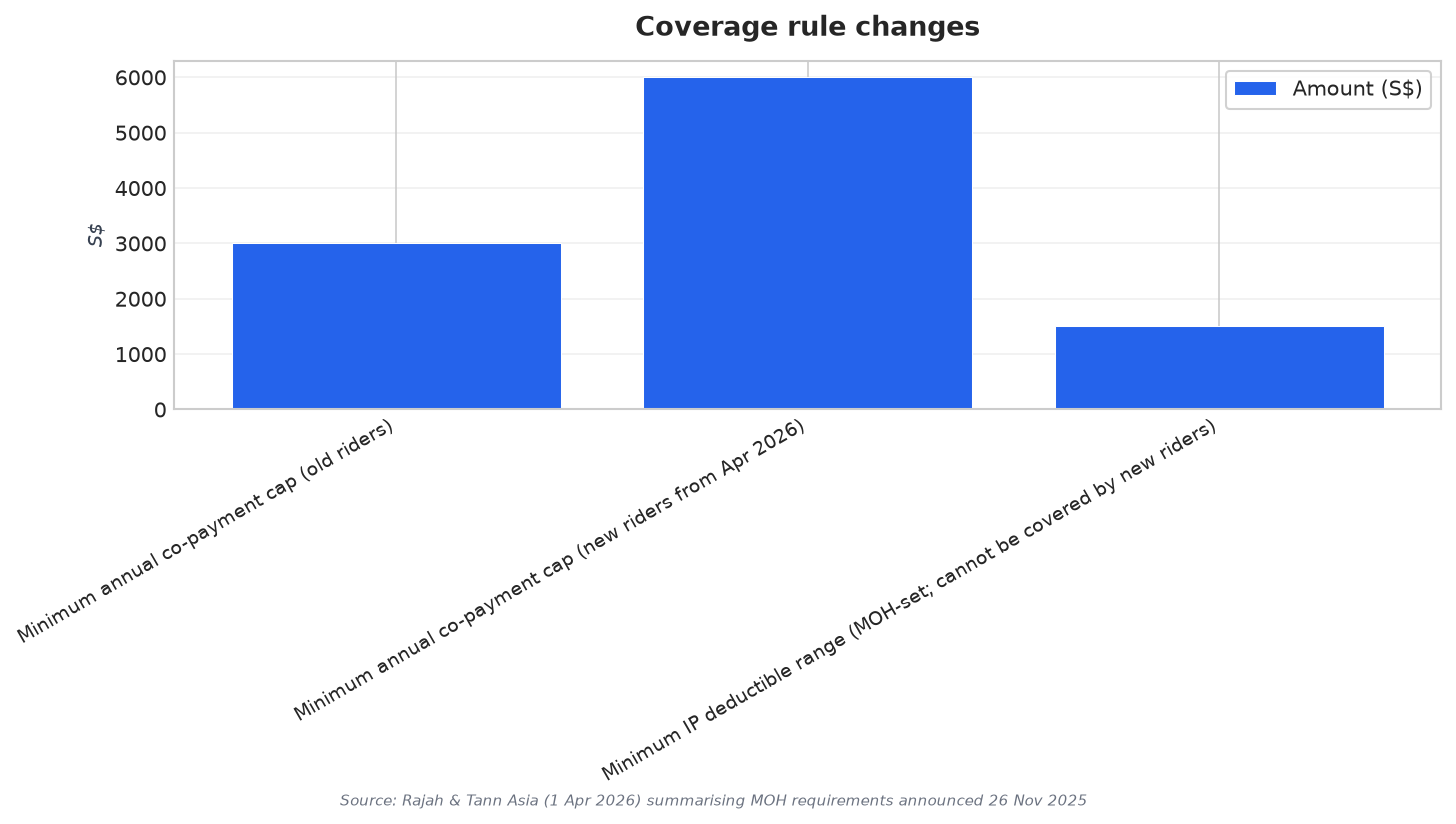
The other major change is the deductible. MOH said new riders cannot cover the minimum plan deductible, meaning patients must pay that deductible themselves before insurance payouts begin. MOH sets these minimum IP deductibles, and they range from S$1,500 to S$3,500 per policy year, depending on ward class. MOH also clarified that the S$6,000 co-payment cap for new riders applies to co-payments excluding deductibles. In other words, a patient may face both the deductible (within that S$1,500 to S$3,500 range, depending on coverage) and a 5% co-payment on the remaining bill, subject to the rider’s cap rules. MediSave funds can be used to pay both deductibles and co-payments, subject to prevailing withdrawal limits.
Why MOH Is Tightening Rider Coverage (and What Patients Should Watch)
MOH has linked very comprehensive rider coverage to behaviours that can push costs up. It said that coverage that “protects up to almost the last dollar” can be expensive and can drive higher healthcare costs. Minimal co-payments can encourage patients to overconsume healthcare services and providers to overservice them. In this context, the tighter rider rules are meant to refocus insurance on protecting against large bills, rather than removing nearly all day-to-day cost-sharing. For patients, the key watch-out is that the out-of-pocket limit is changing: the minimum co-payment cap moves from S$3,000 to S$6,000 a year for new riders, while the deductible is no longer something the rider can absorb.
These changes matter because IP and rider ownership is common. MOH said about 71% of Singapore residents, or around 3 million people, have Integrated Shield Plans, and 67% of these, about 2 million people, have riders. MOH also said that half of IP policyholders are on plans for private hospitals, and 80% of them have riders. For buyers comparing options, the new rules also reshape pricing expectations. MOH estimates that premiums for new IP riders will be about 30% lower on average than existing riders with maximum coverage. One source summarising the expected impact said private hospital IP rider policyholders may expect annual premium savings of around S$600, while public hospital rider policyholders may expect around S$200, with older policyholders enjoying greater savings.
Timing also matters. Insurers can continue selling existing riders until 31 March 2026, but from 1 April 2026 they must launch new compliant riders and cease selling non-compliant ones. For those who purchased certain riders on or after 27 November 2025, insurers must inform them that they will transition to compliant riders no later than their next policy renewal after 1 April 2028. If you are trying to understand the Singapore Integrated Shield Plan rider changes 2026 from a patient perspective, focus on three levers: the deductible you must now shoulder (within MOH’s minimum range), the continuing 5% co-payment, and the higher minimum annual cap of S$6,000 for co-payments excluding deductibles. These determine your likely out-of-pocket exposure when you choose providers and ward classes.
What changes for new IP riders from 1 April 2026?
How much is the IP deductible that riders can no longer cover?
Does the S$6,000 cap include the deductible?
Will premiums fall under the new rider design?
How do the Singapore Integrated Shield Plan rider changes in 2026 affect existing policyholders?