
Singapore’s North-South Corridor has hit another schedule reset, and the reason is not paperwork. The Land Transport Authority (LTA) said the opening will be delayed by two years due to “unexpectedly challenging ground conditions” that required more complex construction methods. The NSC is a multi-modal transport link spanning more than 20km, and one report describes it as 21.5km, with construction ongoing since 2018. What was previously announced as an opening in stages from 2027 has been revised: the viaduct section is now expected to open in phases from 2029, while the tunnel section will follow with phased openings from 2031.
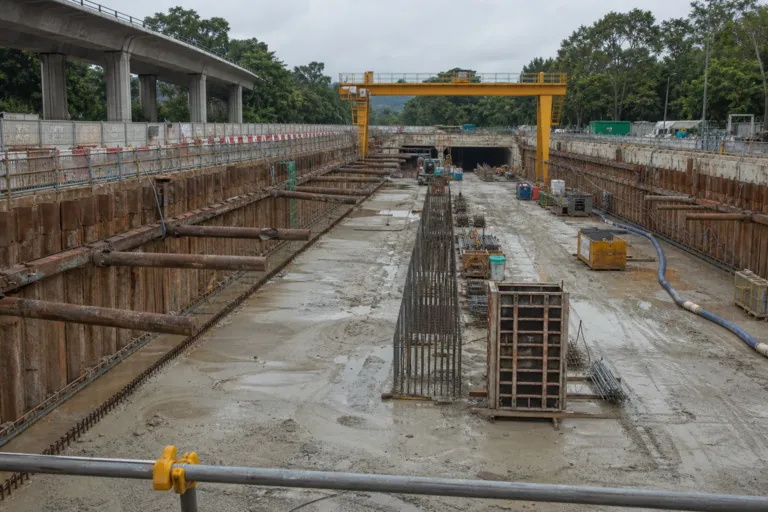
The new dates also clarify which parts move first. The project comprises an 8.8km elevated viaduct and a 12.3km underground tunnel section. Under the updated timeline, the viaduct from Admiralty Road West to Lentor Avenue is now planned to open in phases starting in 2029. The tunnel from Lentor Avenue to the East Coast Parkway (ECP) is now expected to open in phases from 2031 instead of 2029. This is the core of the Singapore North-South Corridor delay 2031 story: the later years are tied to the most technically demanding underground works, where “ground truth” has diverged from what earlier investigations indicated.
Why Harder Rock and Tight Clearances Forced Slower Methods
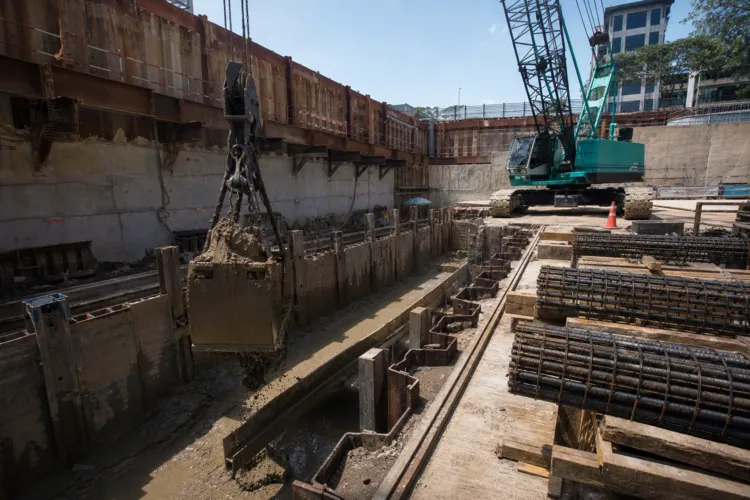
The engineering narrative is unusually specific. LTA highlighted tough sites including Novena, where the NSC tunnels intersect with the operational North-South Line MRT tunnels under severe space constraints. The southbound tunnel runs above the MRT tunnels and has been completed, but the northbound tunnel runs below and hit fractured rock and groundwater inflows. LTA shifted from direct tunnelling to a more precise mining method, excavating in smaller sections. In addition, the fractured rock was found along the lower half of the northbound tunnel, requiring excavation in two phases, with the top half cutting through softer ground with water seepage and the bottom half requiring excavation through solid rock.
Elsewhere, harder-than-expected rock formations also slowed progress. In Gambas Avenue and Woodlands Avenue 8, the rock level underground was found to be higher and harder than expected, and foundation work took longer than planned. LTA also pointed to the Thomson area as a challenging stretch, where rock blasting and ground stabilisation works were needed before excavation could proceed, and reinstatement around Thomson Road near the Pan Island Expressway (PIE) interchange is expected from 2030. One report said contractors in the Thomson and Woodlands stretches removed rock volumes equivalent to seven Olympic-sized swimming pools, underscoring why construction sequences had to be revised instead of simply sped up.
The slip has a street-level impact that officials addressed alongside the engineering details. LTA said roads, footpaths and other adjacent areas occupied by construction will be progressively reinstated for public use from 2028, as major structural works are completed. Transport Minister Jeffrey Siow told Parliament that major structural works generating the heaviest noise and dust are scheduled for completion by the end of 2027, with surface spaces progressively reinstated from 2028, and surface restoration along Lentor Avenue and Sembawang Road expected by mid-2028. Businesses have reported severe customer drops, including some citing declines of up to 75 percent, and LTA has installed guide banners and worked on more direct pedestrian walking routes to support nearby retail and F&B outlets during the extended works.
When will the North-South Corridor open after the latest delay?
What caused the Singapore North-South Corridor delay toward 2031?
What is the size and structure of the North-South Corridor project?
When will roads and footpaths be reinstated along the corridor?