
Tariff uncertainty and rerouted trade flows are reshaping how companies design supply chains in Southeast Asia. An RSIS commentary argues that, during tariff escalation—especially when direct US–China flows become restricted or politically sensitive—Singapore “absorbs these shocks, facilitates rerouting, and maintains the tempo of trade through regulatory clarity and robust logistics.” The same piece positions Singapore as a stabilising node in high-tech supply chains amid US–China tariff wars and technology competition. This matters because Singapore also frames resilience as protecting the flow of essentials, including food, medicine, fuel, industrial supplies, and other critical items needed for essential services.
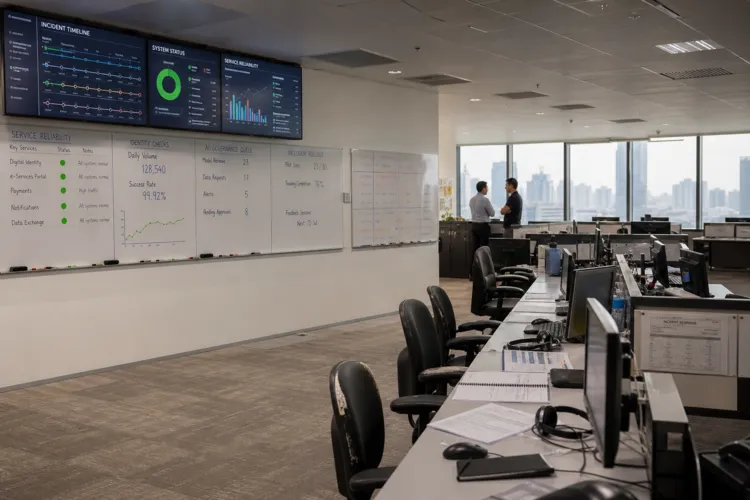
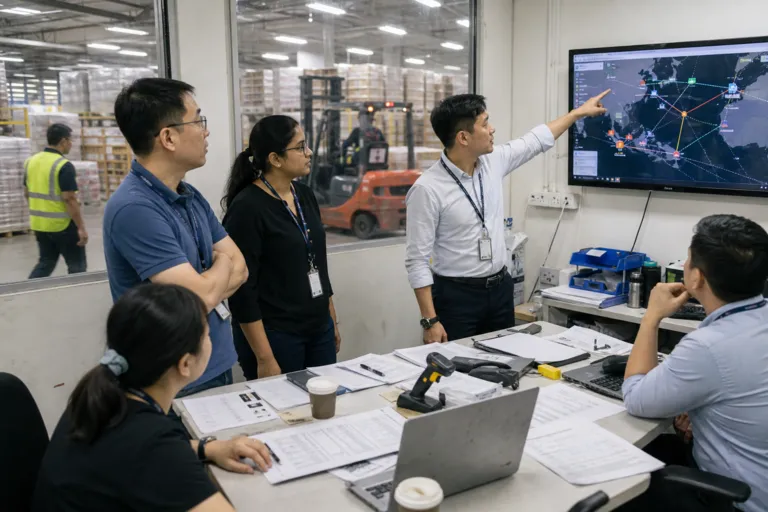
In parallel, a broader 2026 view of global trade suggests supply chains are being redesigned rather than reversed. BIIA reports global trade hit USD 35 trillion in 2025, even amid geopolitical tensions, climate shocks, and tariff uncertainty. It describes ASEAN as a beneficiary of this redesign, with Singapore positioned as an orchestrator of regional trade, finance, and compliance alongside manufacturing and refining specialisations across Vietnam, Malaysia, Indonesia, and Thailand. The same source describes “scenario-based resilience” as a shift from crisis firefighting to continuous planning, with Singapore-based multinationals using multi-country sourcing across ASEAN, supplier diversification mapping with analytics, and real-time risk dashboards that integrate credit, compliance, and shipping data.
From Port Automation to Digital Trade: The 2026 Resilience Stack
Hard infrastructure is a core part of the resilience stack, and several sources point to Tuas as a centerpiece. Mordor Intelligence states the Tuas Port complex was built for an ultimate capacity of 65 million TEU, began Phase 1 operations in September 2024, and is already handling automated yard moves that reduce berth time by 20%. IndexBox likewise describes a future in which the facility is anticipated to be fully operational in the 2040s, with an annual handling capacity of 65 million TEUs and a focus on automation, AI, and intelligent logistics systems to boost efficiency, cut turnaround times, and enhance regional resilience. Mordor also describes a SGD 647.5 million (USD 476.65 million) Supply Chain Hub scheduled for 2027 completion that will integrate autonomous cranes with the SGTraDex data layer to enable real-time inventory repositioning for manufacturers.
Digital rails and compliance-ready documentation are the other half of the story. BIIA describes AI as becoming the operating system for supply chains, used to predict constraints, automate corrective logistics actions, optimise supplier mix, forecast demand, and reduce cost volatility. It also points to ASEAN’s digital trade infrastructure, including Singapore’s TradeTrust and Electronic Bill of Lading adoption, as accelerants for this shift. For Singapore supply chain resilience in 2026, the practical outcome is a hub that can support scenario planning, rerouting, and faster coordination across shippers, financiers, and logistics operators—without relying on a single route or single supplier set.
Market signals show logistics capacity and services continuing to scale, even as constraints remain. Credence Research values the Singapore freight and logistics market at USD 61180.07 million in 2023 and projects it will reach USD 85485.93 million by 2032 at a CAGR of 3.67%, citing drivers such as infrastructure, trade liberalization, and digital transformation, plus adoption of automation, AI, and blockchain. Mordor Intelligence, using a different scope, values the Singapore freight and logistics market at USD 26.11 billion in 2026 and projects USD 35.37 billion by 2031 at a CAGR of 6.26%. These forecasts differ, but both describe a sector investing into automation and new compliance requirements. In that context, Singapore’s resilience strategy also extends to targeted industrial capabilities—from semiconductor manufacturing equipment and precision engineering automation to food systems aligned with the “30 by 30” goal to produce 30% of nutritional needs locally by 2030.
How is Singapore helping firms cope with tariff-driven reroutes?
What Tuas Port figures matter most for resilience planning?
What is the 2027 Supply Chain Hub described in the sources?
How does digital trade support Singapore’s supply chain resilience in 2026?
What do the forecasts say about the Singapore freight and logistics market?