
For many people who cross between Johor Bahru and Singapore, time is the real toll. One source describes commuters waking before dawn and even walking across the Causeway to avoid brutal traffic jams. The RTS Link is presented as a way to remove the uncertainty that turns a simple trip into a daily endurance test, with one article framing it as eliminating “3-hour traffic delays” that undermine urban liveability. The same source ties the problem to scale, citing cross-border congestion affecting approximately 350,000 daily travelers and noting how unreliable journeys ripple into sleep loss, stress, and business scheduling issues.
The rail project is also described in clear investment terms. One report places the RTS Link at RM5.24 billion, also stated as S$1.69 billion, and positions it as a major infrastructure development drawing attention from investors, planners, and commuters. Another article notes a 400% search volume growth around the RTS Link, highlighting how public interest is accelerating alongside construction updates. The overall promise is straightforward: swap road-based unpredictability for a rail service designed to be consistent, faster, and easier to plan around.
What “Six Minutes” Really Means for the Border
The core transformation is the time profile. Multiple sources describe the trip itself as five minutes, with peak-hour frequencies of 3.6 minutes. The line is stated as spanning 4 kilometers, linking Woodlands North in Singapore to Bukit Chagar in Johor Bahru. Capacity is framed at up to 10,000 people per hour in each direction, and one source projects this could reduce traffic on the existing Johor–Singapore Causeway border crossing by at least 35%. In parallel, service planning includes off-peak intervals stretching to 30 minutes, aligning frequency to demand rather than leaving riders guessing.
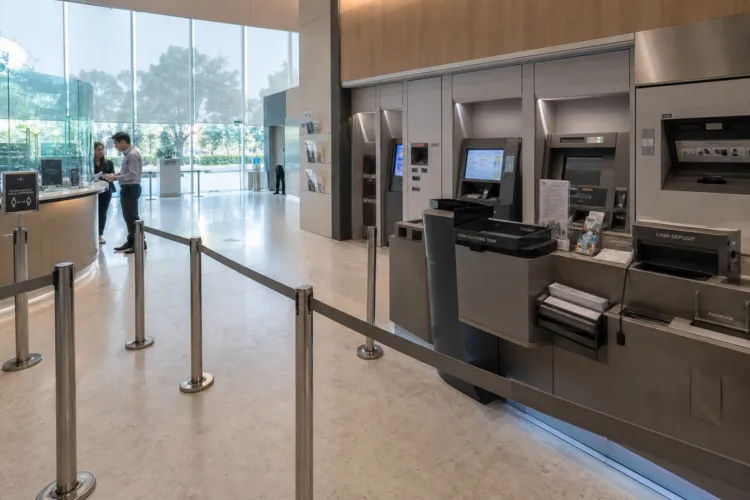
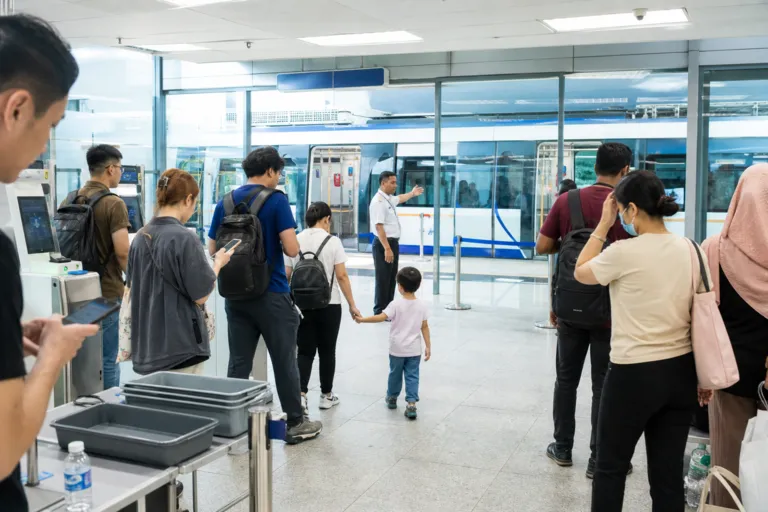
Border processing is designed to change too. Sources describe co-located immigration facilities at Woodlands North and Bukit Chagar, where passengers clear authorities of both countries at the departure point rather than the arrival point. RTS Operations Pte Ltd is identified as the operator, and it is also conducting market studies to set pricing that encourages ridership while ensuring financial sustainability. An open payment system is planned, including multiple payment options such as contactless cards and mobile payment applications, aimed at reducing friction for frequent riders who need speed and simplicity.
The system is also being built to handle real commuter loads, not just occasional trips. One report says the project is 56% complete and describes eight driverless trains with an optimal capacity of 607 passengers and a maximum of 1,087. The same source states the trains will operate at speeds up to 80 km/h, with service running from 6am to midnight, and that the first driverless train was unveiled in Singapore on June 30, 2025. For readers tracking the Johor Singapore RTS Link 2027 conversation, the sources point to an operational target of December 2026, with the system framed as a proof of concept for cross-border rapid transit in Southeast Asia.
How fast will the RTS Link trip be between Woodlands North and Bukit Chagar?
How much passenger volume is the RTS Link designed to carry?
What is different about immigration clearance on the RTS Link?
What do sources say about the Johor Singapore RTS Link 2027 timeline people discuss?
How much is the RTS Link investment reported to be worth?