
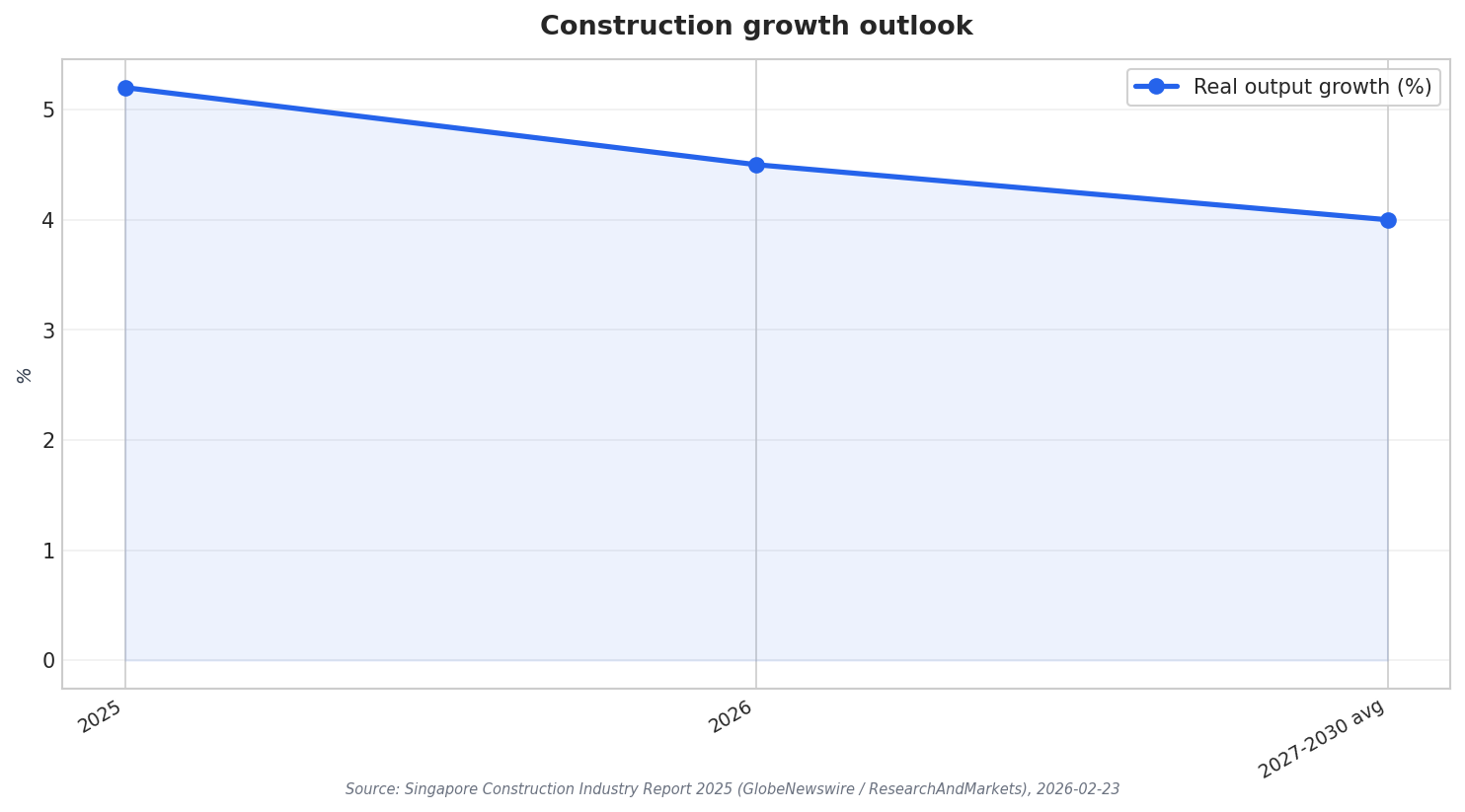
For 2026, multiple sources point to a constructive Singapore construction outlook 2026 narrative, with growth tied to both demand-side activity and project execution indicators. ResearchAndMarkets.com estimates Singapore’s construction industry will grow by 4.5% in real terms in 2026, supported by increased export activities and investments in data centre buildings and the manufacturing sector, in line with rising demand for artificial intelligence (AI). That macro backdrop also includes trade performance: the Ministry of Trade and Industry reported that benchmark non-oil domestic exports grew by 8.6% year-on-year (YoY) in real terms in 2025, following 0.2% YoY growth in 2024. Electronics expanded by 12.7% YoY in 2025, alongside sectors such as pharmaceuticals and specialized machinery.
Construction momentum also shows up in administrative measures of work done and work awarded. According to Singapore’s Department of Statistics (DOS), the total value of progress payments issued rose by 13.2% YoY in 2025, and the total value of construction contracts issued grew by 8.6% YoY in 2025. Another ResearchAndMarkets.com update adds that in January–September 2025, progress payments issued rose by 7.8% YoY, while construction contracts issued increased by 8.3% YoY in the same period. These figures do not replace project-level detail, but they do signal active pipelines and continued spending flow. In the same forward-looking context, the Building and Construction Authority (BCA) projected Singapore’s total construction demand will average SGD39 billion ($29.5 billion) to SGD46 billion ($34.8 billion) per year over the late-2020s forecast windows cited in the sources.
Why Data Centres and Advanced Manufacturing Stay Central
Data centre construction is a measurable, fast-moving demand driver within the wider market. Mordor Intelligence projects the Singapore data center construction market will expand from USD 4.56 billion in 2025 and USD 4.75 billion in 2026 to USD 5.96 billion by 2031, registering a 4.64% CAGR from 2026 to 2031. The same source notes that tier 3 facilities held 53.64% market share in 2025, while tier 4 builds are projected to grow at a 5.43% CAGR through 2031. By infrastructure spend, electrical systems accounted for 37.38% of market size in 2025, while mechanical systems are projected to rise at a 5.87% CAGR through 2031, reflecting the shift toward higher-density designs. Arizton adds that an initial 80 MW allocation is expected to add capacity between 2026 and 2028, and that the government is making efforts to provide up to 300 MW of data center capacity in the future.
Manufacturing-linked construction demand is also highlighted across sources, especially where AI-related investment intersects with industrial space needs. The ResearchAndMarkets.com 2026 outlook ties construction growth to investments in the manufacturing sector, alongside datacentre buildings, and notes that improved manufacturing activities can boost industry output. SJ Group’s Singapore Construction Market Review and Outlook 2026 similarly states that industrial demand is expected to remain supported by growth in advanced manufacturing and data centres, particularly in AI-related sectors. These industrial drivers sit beside a public-sector pipeline: SJ Group projects total construction demand at SGD47 billion to SGD53 billion in 2026 after reaching SGD50.5 billion in 2025, driven largely by infrastructure and institutional projects, and points to major developments including works for Changi Airport Terminal 5, MRT expansions, and healthcare projects.
Public spending plans and long-range infrastructure commitments add another layer to the 2026 outlook. The FY 2026–27 budget includes expenditure of SGD137.3 billion ($103.9 billion), a 10.3% increase from FY 2024–25, with SGD34.1 billion ($25.8 billion) allocated for development projects and SGD103.3 billion ($78.2 billion) for operations. Over a longer horizon, Singapore’s Long-Term Plan Review set out a 50-year framework and included rail expansion, with the MRT network set to grow from 250 km to 360 km by the 2030s. Cost and delivery risks still matter: SJ Group forecasts construction costs to rise by 2% to 5% in 2026, while noting material prices are already up by 5% to 15% amid disruptions linked to tensions in the Middle East. Even so, the same review emphasizes sustained government investment and a steady pipeline of projects.
What is the expected growth rate in the Singapore construction outlook for 2026?
Which 2025 indicators suggest construction activity is still moving in Singapore?
How large is Singapore’s data center construction market in the mid-2020s?
What power allocations are mentioned for future data centre capacity in Singapore?
What construction cost pressures are expected in 2026?