
Singapore’s logistics strategy in 2026 is built around its role as a regional gateway. Market intelligence from the U.S. International Trade Administration describes Singapore as a premier supply chain and logistics hub and a strategic entry point to the ASEAN region of more than 650 million people. Trade flows help explain why. In 2024, Singapore recorded approximately $1 trillion in merchandise trade and $800 billion in services trade. Demand is tied to electronics and semiconductors, chemicals and petrochemicals, biomedical and pharmaceutical products, advanced manufacturing, and e-commerce. This mix is also why high-value air cargo is a focal point, not just a volume play.
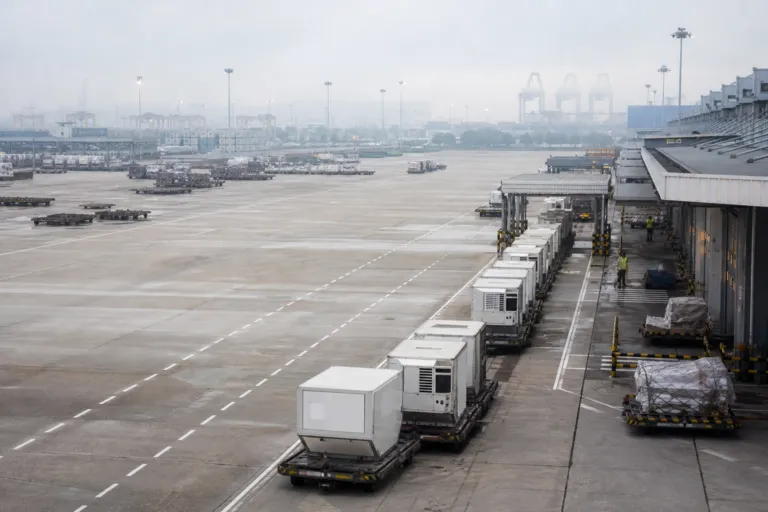
Air connectivity is already a base advantage. Singapore is Southeast Asia’s largest air cargo hub, with almost 7,000 weekly flights operated by nearly 100 carriers. The next push is capacity and specialization. The Airport Logistics Park of Singapore is projected to lift annual air cargo capacity from 3 million tonnes to more than 5 million tonnes. The intent is to serve growth in e-commerce while also scaling specialized cargo such as pharmaceuticals, biologics, semiconductors, and medical devices. For planning discussions around Singapore Airport Logistics Park ALPS air cargo 2026, the capacity step-up and the cargo mix are the key signals to watch.
Building the High-Value Backbone: Cold Chain, 3PL, and Tech
High-value cargo also depends on temperature control and handling depth. Changi Airport handled 1.99 million tons of cargo in 2024, a 14.6% increase, as air freight recovery strengthened perishable handling. On the facility side, SATS Coolport has an annual handling capacity of 250,000 tons for perishables. Industry reporting also notes that Singapore’s cold chain warehouse and storage is the largest solution segment at 57.76%, and large-scale facilities above 5,000 MT hold the biggest share by storage capacity at 41.3%. These data points matter for pharma shipments where compliance and stable operations shape service reliability as much as speed.
Third-party logistics providers are scaling alongside this shift. Mordor Intelligence values the Singapore 3PL market at USD 5.76 billion in 2025, estimating growth from USD 6.02 billion in 2026 to USD 7.23 billion by 2031 at a 3.74% CAGR. In 2025, Domestic Transportation Management led by service with a 33.65% share, while Value-Added Warehousing & Distribution is projected to expand at a 4.80% CAGR through 2031. By end user, Technology & Electronics held a 33.16% share in 2025, aligning with the “chips” side of high-value flows. Reporting on cold storage economics also highlights why automation is a recurring theme: in Singapore, electricity can constitute 35–45% of total operating cost for a cold storage facility.
ALPS sits inside a wider infrastructure and digitalization agenda. The government’s Networked Trade Platform digitizes trade documentation and connects shippers, customs authorities, freight forwarders, banks, and logistics providers. Singapore is also investing in AI-driven analytics, IoT-enabled tracking systems, autonomous vehicles, warehouse automation, and predictive maintenance. On the sea side, the Tuas Mega Port is scheduled for full completion in the 2040s and is planned to reach 65 million TEUs annually, consolidating container operations into one high-tech facility. For high-value air cargo, the takeaway is coherence: capacity expansion at the airport, specialized handling for temperature-sensitive goods, and digitized trade workflows designed to reduce friction in cross-border movement.
How is the Airport Logistics Park of Singapore expected to change air cargo capacity?
What air connectivity scale supports Singapore’s air cargo hub position?
What indicators show momentum in cargo and perishables handling at Changi?
How does 3PL growth tie into scaling high-value logistics for electronics and pharma?
What should stakeholders track when planning for Singapore Airport Logistics Park ALPS air cargo 2026?