
Singapore’s health system is already built on shared responsibility across public and private participation, anchored by the “S+3Ms” financing framework: MediSave, MediShield Life, and MediFund. All Singapore citizens and permanent residents are covered by MediShield Life, and private Integrated Shield Plans are widely used as a supplement: 31% of residents are covered by MediShield Life only, while 69% also hold Integrated Shield Plans. In 2022, government spending accounted for 57% of health expenditure, with out-of-pocket spending at 25.4% of total health care spend. Healthier SG builds on this base by shifting the center of gravity toward planned prevention, especially through the family doctor relationship and more structured health journeys.
The policy logic is also shaped by capacity and equity. The Commonwealth Fund notes primary care access and chronic disease management remain challenging, especially for those with lower incomes. It also highlights that the nonresident population made up nearly a third of Singapore’s population in 2024, yet these individuals are not eligible for government subsidies and often rely on employer-provided insurance that “often falls short.” This group has a higher likelihood of seeking emergency care and faces challenges with planned hospital visits and follow-up care, including being more likely to leave hospital against medical advice and to miss appointments. In that context, the shift to prevention changes not just clinical decisions, but how the care economy plans outreach, continuity, and navigation.
Where the Prevention Shift Creates New Demand
Healthier SG’s preventive direction is not only a public-health message; it reallocates spending, workflows, and vendor priorities. Indsights reports that to implement Healthier SG, Singapore plans to invest over $1 billion for setup costs, including new tech systems and support for general practitioner clinics. On the service delivery side, the market signal is visible in screening and check-up behavior. Grand View Research’s Singapore outlook segments the health check-up market into general, routine and wellness, preventive, and specialized check-ups, and identifies preventive health check-ups as the most lucrative type segment registering the fastest growth during the forecast period. Together, these points indicate a care economy leaning into earlier detection, structured follow-ups, and digital enablement inside primary care.
The operational reality of prevention is targeting the people who drive utilization and cost. A population health analysis in Annals Singapore describes Healthier SG as a multi-year strategy launched by the Ministry of Health (MOH) in 2023, with a key feature supporting three healthcare clusters in managing primary care, intermediate and long-term care (ILTC), and hospitals for residents within their catchment areas. In the same analysis, an annual gross bill threshold of SGD3700 (estimated at CGH) was used to identify persistent high utilisers among patients who had visited CGH in 2020–2022. The study also points to the resourcing needed for early identification and coordination, including manpower and IT infrastructure for predictive tools, plus workflow and IT integration to reduce fragmentation between hospital, community, and primary care.
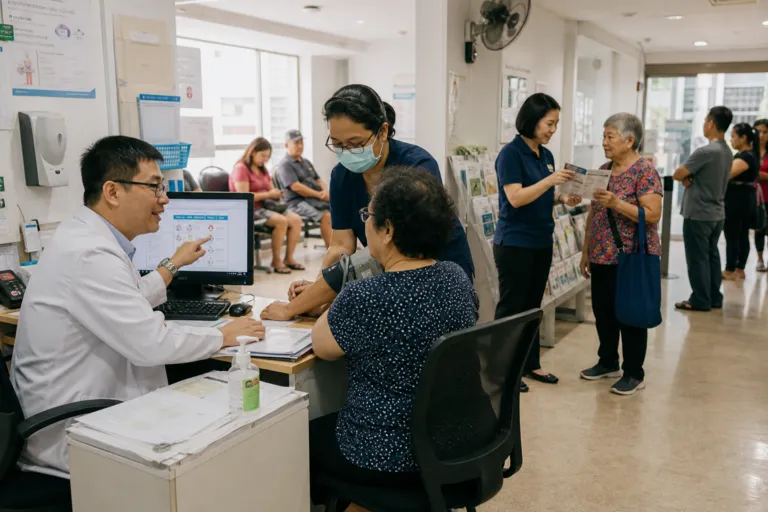
For individuals, this shift is framed as practical, personalized prevention rather than one-size-fits-all. SATA CommHealth describes the national move “from treatment to prevention” and notes that from 1990 to 2019, disability-adjusted life years (DALYs) in Singapore dropped by 40%, reflecting improvements in preventive care. It also outlines phased invitations for Healthier SG enrollment: Singapore citizens and PRs aged 60+ were invited from July 2023 via SMS, and residents aged 40–59 have invitations sent progressively via SMS. In this environment, Healthier SG preventive care is reshaping the care economy around screenings, vaccinations, personalized care plans, and the connective tissue—data, coordination, and patient engagement—that keeps prevention continuous rather than episodic.
How is Healthier SG changing Singapore’s care economy?
What funding and spending context shapes the move to prevention in Singapore?
What figures show momentum behind preventive health check-ups in Singapore?
What does research say about targeting high healthcare service utilisers?
What does “Healthier SG preventive care” look like for residents in practice?