Singapore is adjusting CareShield Life so the scheme can better support people who develop severe disability and need help with basic long-term care needs. The Ministry of Health (MOH) said the Government accepted the CareShield Life Council’s recommendations for the CareShield Life 2025 Review, and the changes will be implemented progressively from January 2026. A key tension is clear in the review: higher payouts mean higher premiums. To cushion the premium increases tied to the payout changes, the Government will provide over S$570 million more in premium support over the next five years. MOH also stated that all premiums will remain fully payable by MediSave, and no one will lose CareShield Life coverage due to an inability to pay premiums.
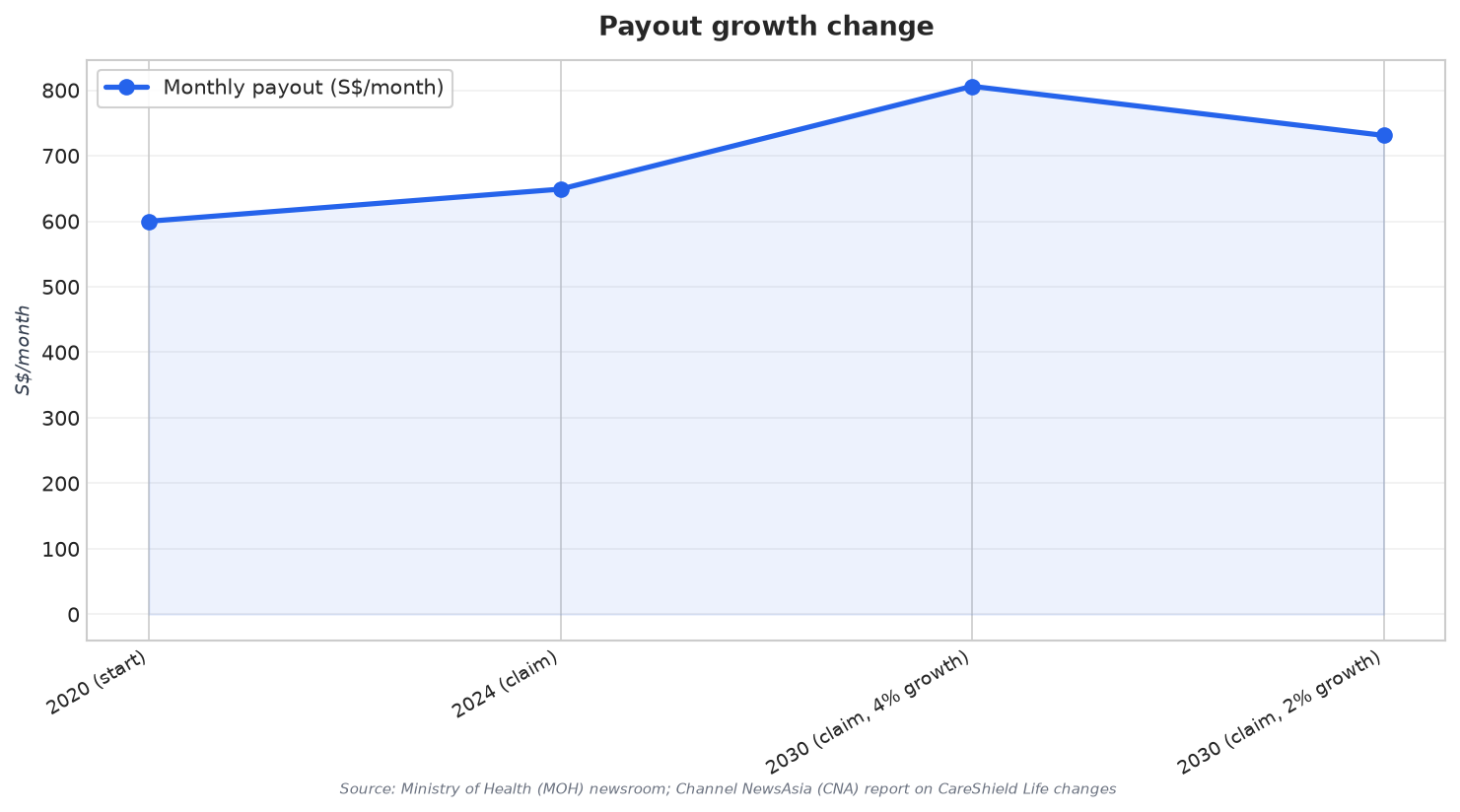
The payout changes are designed to better keep pace with rising long-term care costs. Under the update announced by MOH and reported by CNA, the annual growth rate of CareShield Life payouts will be doubled from 2% to 4%, with the same eligibility criteria for claims. With this new growth rate, a policyholder making a claim in 2030 will receive S$806 per month, compared with S$731 per month if the growth rate had stayed at 2%. MOH data also states that CareShield Life payouts started at S$600 per month in 2020 and increased by 2% annually until 2025; for example, an individual who makes a successful claim in 2024 receives S$649 per month. These figures help frame why the payout trajectory matters to households planning for care needs.
Why Singapore Is Funding More Premium Support
MOH links the affordability challenge to a broader cost backdrop. Long-term care costs have been increasing due to evolving care needs, and inflation driven by manpower and technology costs. Alongside insurance design changes, the Government highlighted wider support measures announced at Budget 2025. These include enhancing long-term care service subsidies from July 2026 by raising subsidies by up to 15 percentage points to a maximum of 80%, introducing additional cohort subsidies of 5 percentage points for residential long-term care and 15 percentage points for home and community long-term care, and raising the per capita household income eligibility threshold for long-term care subsidies from S$3,600 to S$4,800. Separately, Home Caregiving Grant payouts will be enhanced to up to S$600 per month from April 2026, up from S$400 per month, with the same PCHI threshold raised from S$3,600 to S$4,800.
Premiums are also set to rise as payouts rise, which is where the additional premium support is positioned to soften the impact. From 2026 to 2030, those enrolled will see premiums increase by an average of S$38 annually, and up to S$75 annually, according to MOH as cited by CNA. A separate Singapore-based summary also describes a one-step increase in premiums in 2026, followed by premiums increasing by 4% each year. The policy intent is not only to grow payouts faster, but to do so without pushing people out of coverage. This is the practical center of the Singapore CareShield Life payout boost premium subsidy discussion: bigger future payouts paired with added premium support so households can stay covered as the scheme evolves.
Recent scheme statistics show why policymakers expect pressure to build over time. CNA reported that as of 2024 there were 1,821 active claimants under CareShield Life, with more than S$26 million paid out in claims. Claimants were aged between 30 and 93, with a median age of 52, and MOH noted that about half of claimants are in their 30s and 40s. As of December 2024, S$2.8 billion in CareShield Life premiums had been collected, including about S$800 million of government premium support. MOH also said that over a longer time horizon, as the policyholder pool ages, it expects significantly more claimants over time, reinforcing why adjustments to payouts, premiums, and subsidies are being made together.
How much additional premium support is Singapore providing for CareShield Life?
How will CareShield Life payouts change from 2026?
What does the higher payout growth rate mean for a claim made in 2030?
How big are the premium increases expected to be from 2026 to 2030?
In the Singapore CareShield Life payout boost and premium subsidy changes, can people lose coverage if they cannot pay?