
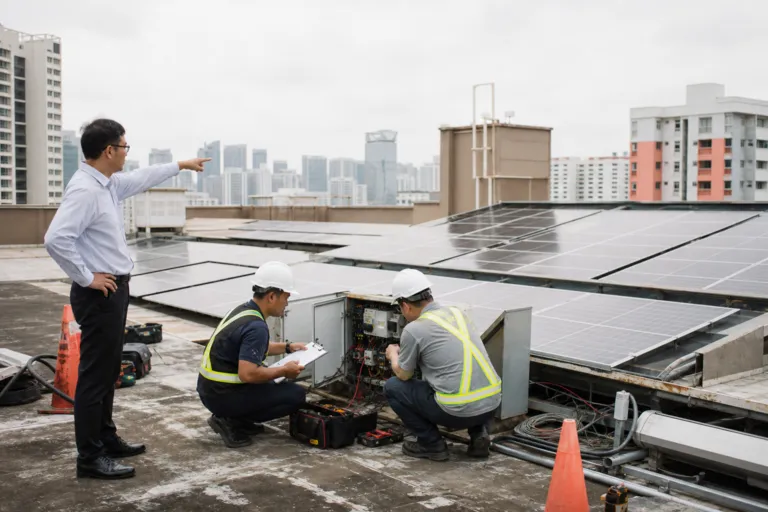
Singapore’s solar story changed in Budget 2026. Prime Minister Lawrence Wong said Singapore is raising its 2030 solar deployment target to 3 gigawatt-peak (GWp) after the country met its earlier 2 GWp target ahead of schedule. EMA separately confirmed that Singapore achieved the milestone of 2 GWp of installed solar capacity in 2025. This sharper target matters because EMA stated that 3 GWp is equivalent to powering around half a million households a year. It also reinforces a policy direction that aims to “maximise solar deployment across all viable surfaces” and then progressively set more ambitious targets further into the future.
The raised target also anchors expectations for how much solar can contribute to the power system. The Straits Times reported that the new 3 GWp target could meet around 4 per cent of Singapore’s total electricity demand in 2030. The same report pointed to longer-run potential from a 2020 Seris study, which estimated Singapore’s solar deployment potential could reach 8.6 GWp by 2050, accounting for about 10 per cent of projected demand then. Those figures highlight both progress and limits. Even as Singapore is described by EMA’s chief executive as “one of the world’s most solar-dense cities”, solar is still one part of a broader transition that must fit a small, built-up island.
What Budget 2026 Signals Beyond Panels on Roofs
Budget 2026 framed solar as a core domestic lever, but not the only one. The Business Times reported that Singapore is also pushing forward plans to import low-carbon electricity from the region, with projects in various stages of development. It added that not all will materialise, but those that do could reduce Singapore’s carbon footprint and strengthen energy resilience. The government is also exploring how to diversify the energy mix through hydrogen, geothermal energy or civilian nuclear power. According to the same Budget coverage, Singapore is building nuclear energy capabilities to assess safety and viability, and has initiated coordination with the US and France, while discussing similar arrangements with partners such as South Korea.
Energy security concerns are also part of the conversation around the Singapore solar energy target 2030. Sunollo’s analysis described how global events can affect local prices, noting that Singapore generates about 94% of its electricity from natural gas. It added that roughly 60% of that gas arrives via pipelines from Malaysia and Indonesia, while about 40% arrives as LNG, and around 25% of Singapore’s gas comes from Qatar. In this context, domestic solar deployment is often discussed as a way to reduce exposure at the margin, even if it cannot replace the existing system overnight. Sunollo also cited Q2 2026 household tariffs at 27.27 cents per kWh, alongside EMA warnings of “further and potentially sharper” hikes in Q3.
On the ground, the new 3 GWp goal implies sustained build-out momentum. The Straits Times highlighted specific projects and their relative contribution to the new target: one development, when completed, will generate at least 130 MWp, which would be 4.3 per cent of the 3 GWp target. It also noted that the Ministry of Defence launched its first solar farm at Sembawang Air Base, expected to generate 18 MWp of energy by end-2026. Separately, PVknowhow reported that EMA data shows total installed solar PV capacity has climbed to 1,932 MWp, while also reiterating the Budget 2026 decision to raise the domestic solar target for 2030 to 3 GWp. Together, these datapoints show how the target turns into a project pipeline that can be measured and tracked.
What did Budget 2026 change for Singapore’s solar deployment plans?
How much solar capacity had Singapore already installed by 2025?
What does a 3 GWp target mean in practical terms?
How does the Singapore solar energy target 2030 fit into the wider energy strategy?
Which specific projects were cited as contributing toward the 3 GWp target?